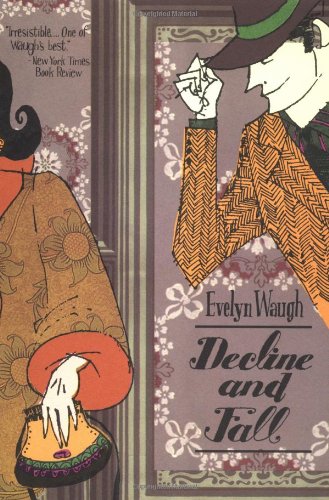
Found this gem of a writing quote in Blockbuster Plots by Martha Alderson. I’ve not read any stories by Barbara Taylor Bradford but I’ve experienced the truth of this writing advice. If your character’s development isn’t driving the plot, there’s something missing in your story.
2013’s best indie rock songs combined simple guitar-strumming with emotive vocals and catchy piano riffs. What separates the top ten from the other great songs on the best indie rock list is usually something a little more, lyrically. While all the songs on this list and the previous top 20 Indie Rock Songs list will keep you jamming all year long, the songs below have the kind of lyrics that bear repeat listening. Either they tackle a more interesting theme, or their poetry puts a new spin on a cliche theme.
Paul McCartney was right: there’s no shortage of good love songs, and yet here we go again. “Outright” (which, really the grammar snob in me feels should be two words) has twice the chance of becoming your latest addiction because it has two hooks. The fast-paced refrain may hook you, but I find the lines “I wish sometimes dreaming was as real as this feeling when I met you” just as catchy as the refrain, even if that line is also grammatically problematic (alas, no one seems to remember the English subjunctive these days). Theoretically, if a CMOS snob like me were to like a song with this many grammatical errors, it would have to be a pretty good tune, eh?
The Neighborhood’s starting to gain chart success in Oakland for their beautifully narrative song “Sweater Weather.” The reason it’s not on this list is that it topped my best-of indie music list last year. (If you’ve been here before, you know I try to stay ahead of the radio). “No Grey” didn’t catch my affection right away, probably because I loved “Sweater Weather” so much that it was hard to follow up. But I found “No Grey” creeping into my subconscious, found myself singing it even before I remembered who wrote it or the name of the song. It deals with a common theme among up-and-coming rock bands: balancing art with commercial success. I love “No Grey” musically, but it gets extra points for tackling a more interesting theme than boy-meets-girl.
Throughout 2013, I knew Daughter would be on this best-of 2013 list, it was just a matter of deciding which song. In some ways, though they’re so different as to not truly be the same genre, Daughter reminds me of The XX. The latter makes dreamier songs while Daughter’s music is more plaintive and folksy, both have mastered the art of subtlety. You’d be forgiven for not noticing there’s both a harp and a violin on this track, as the bare bones of “Youth” are Elena Tonra’s voice and a simple guitar melody.
Daughter’s music is sad, intimate, and the lyrics pull you in. Perhaps the perfect counterpoint to a couple who fell in love listening to Bon Iver is a to listen to Daughter when they break up. “Youth” is the song that captures this the most, with the beautiful idea that all the hipsters are drinking and smoking to set fire to their broken hearts:
And if you’re still breathing, you’re the lucky ones.
‘Cause most of us are heaving through corrupted lungs.
Setting fire to our insides for fun
Collecting names of the lovers that went wrong
A touching song that captures a moment, like a flame wavering in the dark. If you love “Youth,” you’ll enjoy the rest of If You Leave the album’s only flaw is that it’s too short.
Portugal. The Man has partnered with star-producer Danger Mouse to put out a terrific album with Evil Friends. These aren’t grab-you-by-the-neck songs nor do they get you with a pulsing rhythm. “Modern Jesus” is, not surprisingly, an atheist anthem (not the first to grace this site, see “Atheist Funeral” from 2011). When the drums and piano come in on the refrain, all that bass I’ve become accustomed to feels unnecessary. Like “Youth,” “Modern Jesus” is another simple song that rewards with straightforward but elegant lyrics and a perfectly balanced arrangement.
There are so many good tracks on Evil Friends, including the title track and the equally-satisfying “Creep In A T-Shirt.”
I’m a fan of every project Jon Fratelli has been involved in, from The Fratellis to his solo work to Codeine Velvet Club. Most of The Fratellis songs are about wine, women and song, with the wine replaced by something heartier and rustic, as more fitting to a rock band from Glasgow, Scotland.
Below are ten of the best rock songs to come out in 2013. This list has everything from gentle lullabies to angsty guitar licks. What it doesn’t have are the 10 best indie rock songs of 2013, which are still yet to come. But I bet you’ll find these are so good that you won’t mind a bit.
Use the music player on the bottom of the screen to preview the whole list, or right-click and choose “Save as” to download. Songs will play in a new tab if clicked on.
“Literally Baby” isn’t even indie rock. This is good old-fashioned rock and roll that’s a little bit 1955 and a little bit 1995. For the latter I’m thinking of the vocalist, who shouts like one of the many nineties rockers influenced by ska or rockabilly. The piano tinkles like a golden oldie and the triumphant back-up chorus is one of many trills that give the song fullness.
The main reason this song didn’t find better footing on my list is that I’m perplexed by the refrain, which happens to remind me of my biggest grammatical pet peeve. It’s not that he’s using “literally” wrongly, it seems more like for no reason at all. Maybe it’s a reference to the girl having a similar pet peeve—akin to Vampire Weekend’s “Oxford Comma.” But unlike the latter, it’s unclear what the singer is getting at with the refrain. Your thoughts on the lyrical intent?
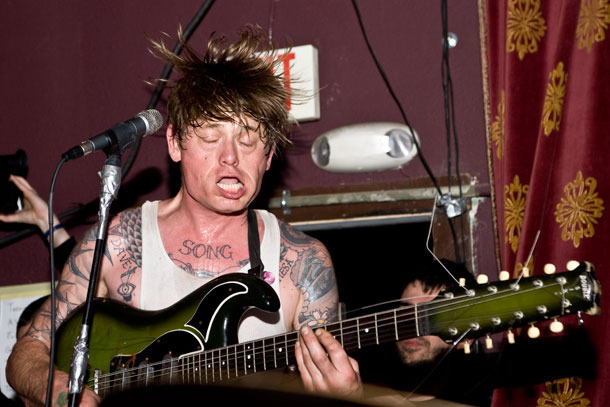
John Dwyer and his thumb buster [image via AlterEXA]
The opening shrill cuts like a knife and the thick, lusty guitar makes me want to sway right from the first riff. Not a lounge-y sway, but a raucous, wide-legged sway, deep enough to be a yoga move, best accompanied by a pumping fist. Next the drums and guitar relent in favor of the singing, unexpectedly soft. This is all just a breather, a chance to prep yourself for some more indulgence to the God of strings. I’m not one for long guitar solos (which half “Thumb Buster” is…I’m wondering if the title is a reference not to the song’s content but what it does to John Dwyer’s fingers). It all fizzles out in skillfully-dosed feedback. Fans of shoegaze and classic rock should check out “Thumb Buster”.
The reason “Needle” didn’t get a better spot on my best of 2013 list is because it starts out too pretty. I like the pretty, but it’s a little too plodding, too plaintive. When the crisp refrain begins it feels like a slow slap in the face. Thirty seconds later I remember why I love this song. When Born Ruffians begin singing “A way! A way!” they have gorgeous harmonies it’s rare to hear in a rock band. And “Needle” does rock when it gets to that refrain. The rockage sneaks up on you.
There’s something to the lyrics too. Most of the song is a plaintive complaint of how the singer doesn’t fit in. But it’s not a sad song, it’s a love song. He’s found that someone, and what are the odds that such an odd fellow would find his needle in the hay?
I belong to no one
A song without an album
Long forgotten maxim spoken to the sea:
I belong with no one/ I belong with no one/ I belong with no one…
you belong with me
The typical lovesong would focus on the object of his affection but “Needle” is mostly lyrical navel-gazing. It’s narcissistic moping is touching because the more of an oddball he is, the more amazing it is that he found her.
Born Ruffians are one of many bands that hasn’t yet gotten the recognition they deserve. In “Needle” they sound a bit like they’re impersonating Vampire Weekend, but many of their best songs are more straightforward rocking out.
Leave it to a Swedish electro band to show us how a synth was meant to be used. “World
Check it: the Best Music of 2013 list is all into brandingOn Fire” is yet another rousing tribute to soundtrack the march towards our dystopic future. “The world has gone mad,” the royal concept sings, and this is the song we lemmings will be dancing to as we go over the edge. Originally one of my top-five favorite songs of 2013, but I overplayed it so it lost its rank. Unfair? Tell me if you think it deserves a better spot.
“I got my headphones on from the minute I’m up to the minute I go to bed.” That’s a refrain I feel more kinship with than I do with 90% of love songs. I love the image of a pair of headphones as a sideways mohawk. These Canadian cops on horses are going to be buried in their headphones, proving they’ve done their homework. The guitar work pulls you in without drawing attention to itself while the chilled-out harmonies have a bit of edge in the refrain.
I’ve been listening to a lot of podcasts lately, among them Slate’s Double X Gabfest. In a recent podcast they discussed the concept of the “basic bitch.” Immediately I thought of Kreayshawn’s 2011 hit, “Gucci Gucci” which proclaims “Gucci Gucci Fendi Vendi Prada: basic bitches wear that shit so I don’t even bother.” At one point in the show one of the hosts declared she wanted a remix of that song, and I am here to supply. How can I resist when Party Ben’s remix is so damn good?
The hosts discussed basic bitches as compared to hipsters. They seem to me to be perfect binary opposites. Both groups are lashing out at the presumptions they expect from their counterpart. The basic bitch thinks the hipster is uppity for not following social conventions (I gave a perfect example of this in my first article on hipsters, sourced from Urban Dictionary’s hipster definition). While the hipster thinks the basic bitch is just the sort of girl who made fun of him/her in school for not wearing the right clothes or participating in sports.
If you’ll allow me to further digress, I was having a tangential conversation last night with a Puerto Rican woman I’d just met. We were drunkenly discussing Florida racial politics (a favorite pastime of mine) in particular the ongoing hatred between Cubans and Puerto Ricans.
She felt that Cubans were the ones keeping this going, always accusing Puerto Ricans of selling out, for not revolting against the Yankee oppressor. This parallax view fascinated me. As one raised amongst Cubans, the narrative was similar, but different. My upbringing taught me it was the Puerto Ricans who started it all, with their big flag necklaces and upper-middle-class pride. True, Cubans were proud of their revolutionary status, but the hatred was coming from the Puerto Ricans. They were the ones bragging about their status, thinking the Cubans were lesser, for both their poverty and their questionable legal status.
Now there’s a lot to this conversation, (and much of it that most people wouldn’t be willing to discuss or admit even sober), but the part that is germane here is that in both cases the prejudice towards the other group stemmed from some underlying insecurity. If that Puerto Rican in fifth grade hadn’t gone basic bitch on me for accidentally referring to her as Cuban, I’d not have had prejudices against Puerto Ricans and their pride flags. The prejudice was born out of my own insecurities. And if hipsters weren’t so frequently taunted and bullied as kids, maybe they wouldn’t be so eager to brag about their current elite taste in coffee, music and thrift shopping.
It’s so easy to see one side of that coin, from whatever side a person happens to identify with most closely. What is fascinating to me is that there’s insecurity coming from both sides. That the basic bitches and the Puerto Ricans were hating from a place of insecurity too. It reminds me that deep down there are no bad people, just terribly broken people in search of healing. And that all gets back to the opening of the Gabest episode, where they discuss the gender confidence gap. Nice when things come full circle, isn’t it (discuss!)?
I promise this remix is better than the one used in the closing credits of the Gabfest…though that one was satisfying too.
OK I really only meant to start this post as an excuse to share this Kreayshawn remix. This junk will really get you dancing. Seriously one of my favorite remixes of the decade, though Kreayshawn won’t inspire the Oakland hipsters like she used to. And for your patience during my rant, I’ll throw in this cover by suspected-hipster never-to-be-a-basic-bitch Neon Hitch. Neon Hitch drops the “basic bitch” from her version, take from that what you will.
If you like this cover, it’s in my Best Electro of 2011 list. There may be more there to your tastes.
PS, the women of the Double X Gabfest claimed Kreayshawn is now a “mommy blogger.” As a media professional well-acquainted with mommy bloggers, I’m going to challenge that. Having just visited her Tumblr, I’d say that Kreayshawn is not at all a mommy blogger, but simply a public figure how happens to be a mom and have a blog. A distinction a group of feminists should surely acknowledge!
While we’re talking favorites of 2013, Kukula was the best artist I discovered last year.
The Top Songs of 2013 playlist continues, with the ten best dance songs playlist. By “best dance songs” I don’t mean “biggest bangers.” Anyone quality producer can lay down a floor shaker and even anthemic crescendos a la David Guetta and Calvin Harris are starting to sound tired. While the tracks below will make your hips shake, they also combine the zeitgeist of EDM right now and the direction dance music is heading.
As I mentioned in the previous post, this year’s crop of best dance tunes had a lot of retro remixes, but you’d not confuse this Clark Kent remix with an earlier dance era. Sure it opens with a ghostly a capella and follows that with a synth that could have come from 1984, but when the dubstep drops in you know this to be firmly 21st century. The washes and the thick bass make the song sick, and I’m just as impressed how he mixed Robinson’s simple piano melody with that very different-sounding synth. But mostly, somehow the Clark Kent remix makes this song sound so much more haunting than I ever thought Smokey Robinson could.
I promised Cashmere Cat would make this list and here he is at number nine. I listened to this remix so much that I went and checked out Miguel, but it turns out what I really like about this song is 100% due to Cashmere Cat. Those looking for bangers may be disappointed to see this track on the list, it’s really an early-evening song. But the best isn’t always the hardest, and I think Miguel is doing unexpected things with his mixes. I love his use of the squeaky bed springs, a tongue-in-cheek reference to sex that’s much fresher than the clichéd sound of a woman moaning. One of the growing trends of 2014 is slowed-down vocals, and this mix demonstrates this nicely. When you first learn mixing, playing with pitch is an easy way to kill a party so I’m doubly impressed to see it done effectively. I also like the way he picked out the particularly fun couplet of this song and focused on it, without making the vocals sound repetitive. Probably because of all that synthy magic he’s mixed together to make this into one delicious soup.
Speaking of early-evening songs, this Wild Belle remix is probably the slowest jam on the list. Yet I can’t help but want to sway when that disco groove kicks in at :50. What’s sophisticated about this remix is how he perfects the original. It’s a good song, but a little repetitve, and Employee of the Year drops some of that, focusing on the strongest lines of the song. “It’s Too Late” would make a great closer (or opener), or a funny ditty for washing dishes, walking the dog, or romancing a first date. Probably too short at just over three minutes, which is all the reason to play it again. If you like this low-tempo number, you should probably check out my best indie pop list.
Let’s pick up the pace a little with some house music. What really grabs me about this song is the fantastic vocals. His gospel-worthy voice combined with the short trumpet frill makes this 2013 song sound like it could have been a remix of some old 70s vinyl from the rummage bin. The group is Italian, so I can’t tell you much about them, all I know is that his enthusiasm is infectious.
I was disappointed by Phoenix’s newest effort after their breakout fourth album. The songs didn’t have that addictive quality that made me want to sing along despite the inexplicable lyrics (to be fair, they’re French). All that is quickly forgotten with Kastra’s irresistible electro remix. The song peaked at number 11 on the US alternative charts, but it’s Kastra’s remix that reminds me what makes electro so exciting and fun. Continue reading Top Songs of 2013: Best Dance Music TOP TEN→
I just had to share this charming animated short of Janis Joplin’s final interview. It addresses some of the criticism she got from feminists of the time.
She says, “You are what you settle for. You’re only as much as you settle for.”
“[life is] a great disc of polished wood that revolves quickly. At first you sit down and watch theothers. They are all trying to sit in the wheel, and they keep getting flung off, and that makes them laugh, and you laugh too. It’s great fun . . . Of course at the very centre there’s a point completely at rest, if one could only find it. . . . Lots of people just enjoy scrambling on and being whisked off and scrambling on again. . . . But the whole point about the wheel is that you needn’t get on it at all. . . . People get hold of ideas about life, and that makes them think they’ve got to join in the game, even if they don’t enjoy it. It doesn’t suit everyone”[11]
At last, here it is: The best pop songs of 2013 that you haven’t heard on the radio. The key word today boys and girls is SYNTH. The more the better. Get it in heaping doses below.
I don’t know why I obsessed over this song all year long. Maybe it’s because it’s so rare to hear a woman in a song who is shamelessly confident without being crass. Or maybe it’s because the lyrics are so evocative. Nah, it’s probably just that piano riff. In any case, it’s one of my absolute favorite songs of 2013.
It speaks volumes about how much I love that Flight Facilities track that this tune from Lily Allen only landed the #2 spot on my list. “Hard Out Here” makes a statement about the state of women in pop music with wit and spunk. It was only released as a single in 2013, but oh, what a track. Without a doubt the best song she has ever done, and that’s saying something. Puts Miley Cyrus to shame.
Definitely check out the video, which is chock full of funny pop references, including a knock at the “Blurred Lines” silver balloons that declare “Robin Thicke has a big cock.”
Another cute little love song featuring a woman and a piano. This track is more upbeat than “Crave” offering handclaps and a piano melody that works as a secondary bass line. And don’t you love the idea of a song about a girl eager to learn your phone number?
I absolutely adore Janelle Monae. I got to see her in concert in 2013, and let me tell you she is flawless. I mean from her outfits to her dancing to her voice, she is a 10/10. All her songs center around an android, loosely based on Fritz Lang’s Metropolis. Some suggest that the lyrics of this song are a veiled reference to lesbianism, and I can only hope so, as I want to be the first to volunteer to have her babies. Once science figures all that out.
Anyway, about the song. It’s funky. You can dance to it, but it’s a slow jam. The first verse is vaguely socially relevant, but not preachy. There are horns and violins. The high hat is a finger snap. And it features the backing vocal “the booty don’t lie” in a way that feels truly empowering (not, like, Niki Menage empowering).
Oh, yeah and Eryka Badu sings on this track too. What more do you want, blood?
You know how in the eighties they had that really fantastic synth, that was even better because it was super fake? Where all the instruments are just fake synth? If you liked that, you’ll like this because Friday Nights has three of them. It’s just synth from dusk til dawn, and a guy who can’t get his sweet lady to call him back. She’s probably too bush shaking her tush to this song.
This list is full of great songs to sing in the shower. “Gold” is the song for hate-crooning, as you soap the back your money-grubbing ex no longer gets to touch. Somehow “Gold” is both dark and light at the same time. The throbbing synth overlaps with a light and tingly piano. He always ends on “I hope you find your dreams” but the part you’ll want to sing the loudest is “I don’t owe you a goddamn thing!” If you like this, you’ll probably like everything else by Sir Sly, who is still waiting their own pocketful of gold for writing gem after underplayed gem.
I haven’t totally wrapped my head around Silver Medallion yet. Is he a rapper? An electro artist? Wait, he’s trained as a classical violinist? There’s zero violin in this song. All I know is I think he’s found the theme for the lost generation, the sad moniker for these young folks who are coming into adulthood during the Great Recession (that’s a proper noun now, right?). Enough with the questions. I’m certain of a few things: the girls in this song probably are figments of his imagination, but they feel real to me. A bit like the lost kids of Bowie’s classic All the Young Dudes…but much easier to dance to.
Nothing here but synth and a kickass beat. There’s a sample that sounds like a synth imitating a bagpipe, and another fast, high synth that swears it just arrived from a John Hughes movie circa 1987. A fun song that didn’t crawl higher on the list only because the other songs ahve stronger lyrics. But if you need something to pogo to at the gym, this will get your juices flowing.
2013 was another good year for dance music. In narrowing down this list, I focused on songs that capture the genres and artists of the zeitgeist…at least as it appears from my weird indie hole in the wall. Thus, there is no Miley Cyrus here, but I was more likely to include Lorde than a comparable remix that felt out of time. Despite such considerations, I think this list has more retro remixes than any previous year. Could it be that 2013’s producers were daydreaming of the sexual revolution? I’m just gonna assume its so.
Normally I don’t go for a song that’s so house-y there’s a sample of a dude shouting, “BASS.” What hooks me on this one is the way they lengthen her vocals, so it sounds like she’s just holding that note for half of forever. It has a dreamy quality too, not as in dreamwave, but as in mystical. There’s a melody in there that could have been ripped from a New Age meditation CD. It’s positively other-worldly.
If the Banks remix were an animated gif [image via Imgur]
Wait, is that a banjo? That breaks into a sick synth? Why, yes that’s precisely what happens at 1:20. Bonus points to Hyperbits for remixing a nifty up-and-coming band.
If you run out of coffee, this rousing number may be the thing you need to get you moving in the morning. Gorgeous harmonies over light tinkly keyboards and so many washes you’ll think you’re in the shower.
If that St. Lucia remix was a little too chipper for your taste, have a bite of this dark, sexy number with some serious bass.”When the Night Is Over” sounds like the kind of song you’d first hear while meeting your new favorite one-night-stand on the dance floor. But it could easily become the kind of song you sing along with on your favorite dance mix. If you wondered what the heck Aeroplane was up to in 2013, it’s because the fellows behind it split. Stephen Fasano of Aeroplane is now The Magician. I hope he plays this name for all its worth: the tux, the rabbit, the wand.
Thanks to Earmilk for being the only blogger of 2013 to share this track. August 2013
For those of you who don’t know JD Samson, s/he’s the beats behind every feminist’s favorite underground electro performance artists. I favor musicians that are a little subversive or queer, even when the music isn’t, so there may be some bias here. But this is a groovy, simple disco number that pleases me every time it pops up on my playlist. It’s not a 3 a.m. song, but it’s one of 2013’s best early songs. The odd metaphor, “My love is so deep it goes all the way through” will get folks flirting.
I’m not going to get into whether Lorde is an indie musician gone pop or whether she’s a pop star faking indie. Regardless it’s obvious that Lorde is 2013’s biggest teen sensation, grabbing the attention of hipsters and yuppies alike. “Royals” was all over the radio and, though it is a silly pop song, on a deeper level I think the lyrics resonated with the zeitgeist. The song isn’t particularly danceable, yet it was so wildly popular last year that it brought a lot of people to the dance floor. Thus it seemed fitting that the very best “Royals” remix wind up on a best of 2013 list.
I listened to every remix of this song I could get my hands on, and then did the same process all over again at the end of the year. Both times, there were really only two remixes that got my attention, this one and the “Royals” remix by San Francisco’s Wild Boyz!. I was surprised that while some of the other remixes had thousands of reposts and likes, this remix only got posted once, on The Music Ninja. So, while I’m confident it’s the best, I’d love to hear your favorite “Royals” remix of the year—and whether you think this one tops it.
To me the biggest musical innovation of 2013, at least for EDM, was the growth of trap music. It seems to pick up where dubstep was beginning to become tiresome, and merge with exciting new directions in hip hop. Team Bayside’s remix is a fine example. It’s a little bit dubstep, a little bit electro, and a little bit hip-hop, combining all synergistically into something better, newer and heavier. It takes a somber hip-hop song but adds the sonic trills of electro with the dark whooba whooba bass of dubstep. This is a 4am song for club revelers long past sober, ready to dance dirty and do all drugs mama warned them about.
Speaking of late-night druggie songs, here’s a familiar favorite with a drop that will hit you like a ton of bricks. Reggae lends itself well to dubstep, and this Toyes song from 1983 has been just begging for a truly solid remix. Last year it got its comeuppance. I wasn’t sure if the remix was truly from 2013, so I asked Terravita on Twitter, and he replied “some time in 2013,” an answer vague enough to make me think he’s been taking advice from a man in The Toyes. If you’ve had just about enough of dubstep, the Smoke Two Joints Terravita remix may just have you changing your mind. His wobbly makes that simple reggae guitar melody sound epic. Sick-sickity-sick.
Queen – We Will Rock You (Kiely Rich Remix) (3:37)
And speaking of epic songs from the days of yore, everyone loves a Queen remix and this Kiely Rich take is no exception. You’d think a remix of a classic song everyone loves would be a no-brainer, but such remixes tend to fail more often than not. The drunks get surly when they can’t sing along, thus too many DJs ruin a classic with too many chops and cuts. The Kiely Rick “We Will Rock You” remix does slice and dice Freddie Mercury’s vocals, but keeps the refrain chant-worthy, while mixing in some new magic to Brian May’s guitar wizardry.
That’s ten remixes for now, but once nap time is over get ready for the top ten dance songs of 2013.
OK, I stole that pun off the Internetz. I also heard from that same dubious source that the year of the fire horse in ancient China families would kill their baby girls, because a fire horse woman would be too powerful. Even as late as the 1960s the abortion rate went up in the year of the fire horse. But this is the year of the wooden horse, so all your babies are safe I suppose.
I happened to be in Nobb Hill during the final day of the Chinese New Year Parade. I made sure to head down hill to Chinatown to catch San Franciscans ringing in the year of the horse. Firecrackers for everyone! Continue reading Year of the Horse→


![Best Music of 2013 [Your New Favorite Band]](https://futureisfiction.com/blog/wp-content/uploads/2014/02/your-new-favorite-band-best-of-2013.jpg)