![Sansa Stark fan art by EnjoyTheBlood with the overlaid text "In the [stet] real life, the monsters win"](https://futureisfiction.com/blog/wp-content/uploads/2015/04/sansa_stark__by_enjoytheblood-d5849o1-678x381.jpg)
I Can Be a Feminist…and Still Dislike Sansa Stark
My beloved Bitch magazine is the latest in a series of articles claiming that the widespread dislike of Game of Thrones’ Sansa Stark is due to misogyny. The argument goes like this:
Make no mistake, Sansa Stark is one tough cookie. Sansa isn’t, however, a typical “strong female character” like her sister Arya. Her strength and power lie in her mind and in her ability to assess, adapt to, and manipulate situations by means other than brute force—something that’s rare on Game of Thrones. In show’s assortment of extremely powerful women, Sansa may fade to the background. But that’s actually part of her goal as a character, because she thrives by sticking to the shadows rather than attracting attention to herself.
The actress playing Stark claims Stark has figured out how to “weaponize femininity, how to turn what looks to casual viewers like a disadvantage into an asset.” Another article asserts:
It annoys me that people only like the feminine characters when they act like male characters. And they always go on about feminism. Like, you’re rooting for the people who look like boys, who act like boys, who fight like boys. Root for the girls who wear dresses and are intellectually very strong.
I too want traditionally feminine characters who manipulate their situation without brute force. But the problem is that Sansa Stark is not meant to be a powerful, feminine woman. She is written to be weak. On purpose. She is forthright when she should be withholding, emotional when she should be strategic. Always reacting rather than planning, always the victim, being batted from one danger to the next.

In fact, the entire clusterfuck of terrible events that happens in season one could all have been prevented if Sansa Stark hadn’t been so foolish to trust the queen mother with things she shouldn’t have said (I’m being vague here for the sake of spoilers). This intel gives the queen the chance to betray Sansa’s father, an event which sets in motion all the terrible things that befall Sansa and her family. Moreover, it’s not as though Sansa took a calculated risk that went awry. She naively thought the queen was her friend. Naivety, not inner strength, seems to be her primary character trait.
I feel like these feminists want to believe that George R.R. Martin has set Stark up as a “strong woman of intelligence” because they want to give him the benefit of the doubt, that he intended to have such a character. They want to believe that Martin means well. But they aren’t giving him enough credit. If Martin wanted to write a character who is “quietly wearing pretty dresses and pushing teacakes around on her plate as she maintains a façade, refusing to break character and betray herself” (as the Bitch article so nicely puts it) he would, and there would be no bickering about who she is and what she stands for. It would be clear. I know that, because he already wrote a character to fill that role, and it isn’t Sansa Stark.
(And no, it isn’t the mother of dragons either, though I think one could make a convincing argument that Daenerys Targaryen’s strength comes not from her army but from her strategy.)
The Strong, Clever, Feminine Heroine of Game of Thrones
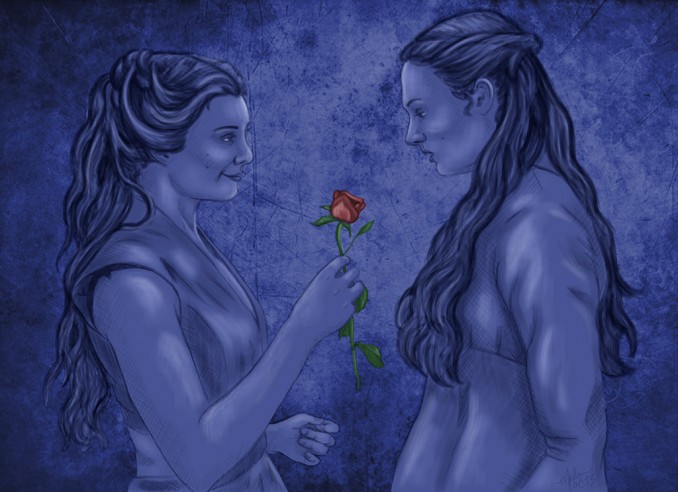
If you want proof, then you need look no further than Margaery Tyrell. Margaery is easily a foil for Sansa, in that both of them have been engaged to the king, and both are living in the same lion’s den. But they handle this situation very differently.
Let’s compare. Sansa Stark had a schoolgirl crush on on the prince, Margaery recognized right away that he was a dangerous psychopath. Sansa Stark’s reaction to figuring this out was to plot her escape (an act that she was too timid to plan herself) while Margaery played on the prince’s sadism to get closer to his shiny, coveted crown. Sansa wants to be a Disney princess; she thinks nothing of politics beyond her own survival. Margaery went out among the people and heard their grievances, and was so bold as to challenge the queen about representing their interests. Sansa fails to recognize her natural ally in the imp, and is way too trusting of Little Finger. If their roles were reversed, there is little doubt that Margaery would have found countless way to exploit a marriage to Tyrion Lannister.
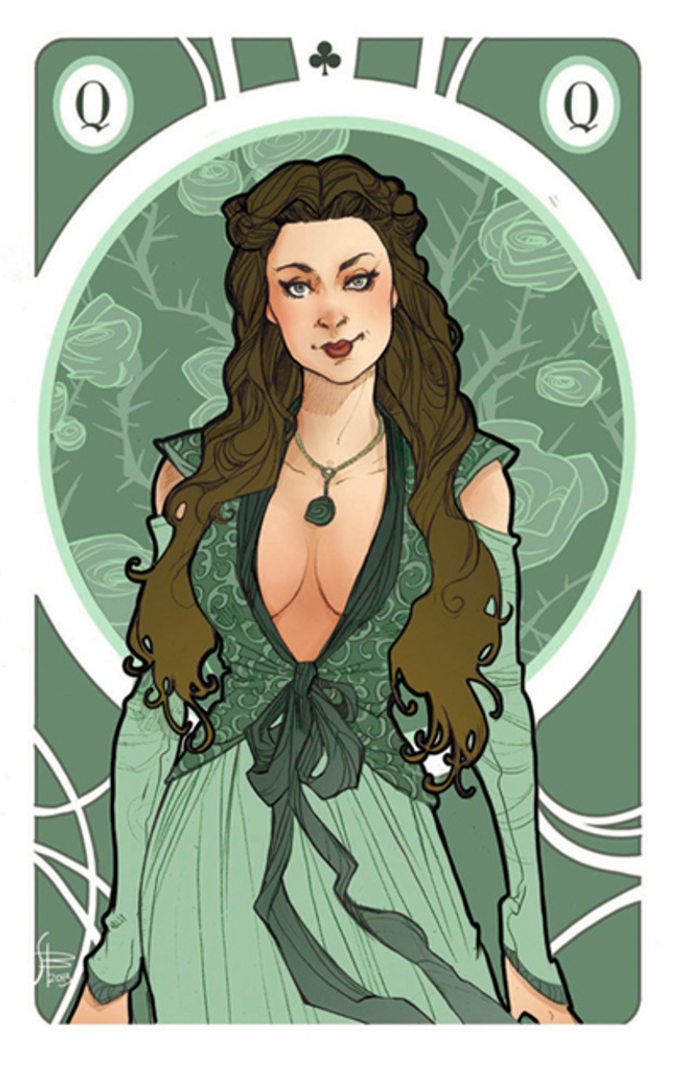
Sure, Sansa lies about her allegiance to stay alive, but this doesn’t make her clever. It’s always tentative and tinged with fear. In contrast, Margaery lies to get what she wants. There are grey areas here: it’s partly due to Sansa’s disclosure that Margaery knew of prince Joffrey’s depravity. But the actions of Margaery show clearly how Sansa is meant to be perceived. Margaery is intended to be the feminine beguiler these other feminists long for while Sansa is intended to be read as weak and naive. Martin demonstrates this not only in their actions, but in the consequences to their actions.
For example, in the latest episode Sansa is again forced to lie **SPOILERS S05E03** when she is offered as a marriage candidate to the psychopaths who brutally murdered her people. Sophie Turner plays this perfectly, showing Sansa’s lies to be believable, while all the time you know she’s doing all she can not to scream bloody murder. Meanwhile, Margaery lies in this episode too. She speaks to the young king about his mother with words of flattery, her intended message buried so far down that when the king questions his mother, he doesn’t even recognize it as her idea. Then when the queen confronts Margaery, her false worship of the queen is laid on so thick the queen is left with no rational way to suggest Margaery may be at fault. Margaery is a gifted deceiver, she does it naturally and well and in the end it gets her what she wants, all the way to the crown. **END SPOILERS**
When Margaery’s ploys succeed, the author is showing us how clever and sly she is. All of her scheming is disguised as someone else’s idea. She plays the innocent, but is constantly advancing her position. She is smart enough to recognize that the queen is her biggest adversary, and daring enough to to look for opportunities to push the queen aside.
In contrast, Sansa Stark is where she is because she has little sense of who she can and should trust. The current scheme she is thrust into was not her idea at all, but Little Finger’s. Imagine if Margaery had the chance Sansa has, SAME SPOILERS AGAIN to regain her castle and avenge her people? I have no doubt not only would she be eager to wed the psychotic Ramsey Bolton but, critically, it would have been her idea. But because this is Sansa, and Ramsey Bolton is just about the worst character in a world of deplorable characters, we get the sense that the Little Bird is again being led into a terrible trap. END SPOILERS Sansa is still too naive to have schemes of her own.
Hating Sansa Stark, Just Like I’m Supposed To

While I don’t like Sansa Stark, I’m not with the unsophisticated reader who would have her shunted from the books, dying suddenly so we can get back to the other characters. I don’t see Sansa’s weakness as a failing of the author. Sure, in a world where most of the other characters are marked by their brilliance, honor, or strength, it’s easy to hate Sansa Stark, who is none of these things.
But we must remember that Sansa is barely more than a girl, and a royal at that, who has lived a sheltered life. Martin needs at least one character like that in the series to show us: this is what happens to naive girls (or boys) in a brutal world. If he killed her off, we’d not get to see how the slings and arrows of fate will turn Sansa into more than a survivor, but a leader.
Much of the world of Game of Thrones centers on this process. We watch young Arya turn from a little girl into a trained killer. We watch Daenerys Targaeryan learn to rule nations. These are plots that have developed not over chapters but over thousands of pages.
Those who would argue that Sansa is strong overlook that her weakness is a deliberate decision the author has made to show us that she is not ready to lead. That’s good writing. That’s character development. In the end, she won’t be another Margaery. Margaery has always been conniving. Her family raised her to be shrewd and careful. Every scene shows that is who she is; that is where she comes form. It makes her wicked, but likeable.
But Sansa is a Stark. She was raised to be honorable. Truth and justice were the values of her parents. She was taught that survival means looking out for your people (after all, winter is coming!) and there will be suffering in any case (did you hear about winter?). She was not taught to be shrewd, and this has led to the ample poor decisions that make her unlikeable. The choices she has made to stay alive go against all that the Starks hold dear. How will she become a worthy daughter to the unimpeachable values of her parents, while navigating a world where such honor will get you killed?
In the game of thrones, “you win or you die” so Sansa must sharpen up, or meet her father’s fate. Watching her story is like watching a pawn advance across a chess board. Martin has written her as a pawn, and rightly so, as her weakness makes the brutality of the knights and queens clashing around her more fearsome to behold. That little pawn keeps moving forward, and it is excruciating to watch unfold. But everyone knows what happens to a pawn that makes it across the board. That is what Sansa’s character is about: not who she is, but the powerful lady Stark she will become.





 This photo is from the