I didn’t want to celebrate 2016, nor was I excited to ring in 2017. The future looks bleak, and we lost so many greats. Especially the loss of David Bowie, which hit me harder than any celebrity death ever has, or likely ever will. So this year, instead of bringing you the best dance music of 2016, I’m offering up a retrospective dance mix comprised of musicians who died in 2016.
Honestly, I wasn’t all that hip to new music this year. I had David Bowie on repeat after his death in January, and with every unarmed black man shot by police, I put Louis Armstrong on repeat. It was a year for listening to Nina Simone and a lot more Louis Armstrong. With so many celebrity deaths, it felt like a year for looking back, not only to those who died, but to those living we might not be honoring because they have the nerve to keep breathing without releasing new albums.
If you’re looking for a retrospective mix, this one touches on most of the notable musical deaths of 2016. Download or stream it right here.
I think this tweeter put it best:
It is becoming increasingly obvious that David Bowie has established a better alternate universe and is populating it selectively one-by-one
NOTE: If you are throw this on at a party, make sure you stop it on the next to the last track. The final track is a Leonard Cohen song read as a poem. It’s not remotely dance-able, and it’s grim enough to suck the cheer out of any room. But I felt it was the right tone to wrap up 2016 (on that note, lots of posts coming up about American fascism).
RIP 2016: Retrospective Playlist of Artists Who Died in 2016
Prince – Let’s Go Crazy
Tribe Called Quest – Can I Kick It?
Wham! – Wake Me Up Before You Go Go
David Bowie – Modern Love
Prince – Seven
Sharon Jones and the Dap-Kings – Natural Born Lover
George Michael – Freedom 90
Sharon Jones and the Dap-Kings – This Land Is Your Land (Woody Guthrie cover)
George Michael – Faith
Leonard Cohen – Partisan (Melle Kuil deep house mix)
David Bowie – Young Americans (Impeach the President remix)
George Michael – Too Funky
Parliament – Flashlight
Prince – Kiss
Vanity 7 – Nasty Girl
Jefferson Airplane – White Rabbit (Fuzzion remix)
David Bowie vs Eric Prydz – Dunproofin’ (Let’s Dance)
Leonard Cohen – Everybody Knows (Tiger Tooth Rerub)
David Bowie – Space Oddity (Munk Machine remix)
Wham! – Everything She Wants (’97 version)
Leonard Cohen – You Want It Darker (Paul Kalkbrenner remix)
Leonard Cohen – Democracy (as a poem, Neil Gaiman with Amanda Palmer on piano)
Dance Along to RIP 2016 with Me
Staying home on New Year’s Eve was a big deal for me. I always go dancing, mostly because its’ the one day of the year I can rally my homebody pals into going out. Like David Bowie says in “Modern Love,” “I don’t want to go out, I want to stay in, get things done.” Since I’d been meaning to try out live-streaming, I decided to ring in the new year dancing to my retrospective playlist. It’s pretty silly, and yes, I’m three sheets to the wind in this video. But if you want some company, or if you just want to have a laugh, you can dance along with me.
This playlist is a little different than the one above. I made a second draft with a few artists I’d left out the first time (Phife Dawg of Tribe Called Quest, Signe Anderson of Jefferson Airplane and Vanity of Vanity 6). Also after the first song it stopped, so I started it anew from where we left off. I am hoping to upload a dancing video with the new edit over it, but LightWorks crashes whenever I open it so it seems unlikely.
Google flagged one of the Prince songs in the video for copyright, so that section is muted, and due to the other tracks, it forces the video to have commercials…I’m beginning to see why people prefer Vevo.
Comments are turned off for this post because I’m moving the articles here from futureisfiction.com/blog to futureisfiction.com, and I can only have spam protection on one or the other. Feel free to reach out to me on social media in the meantime.
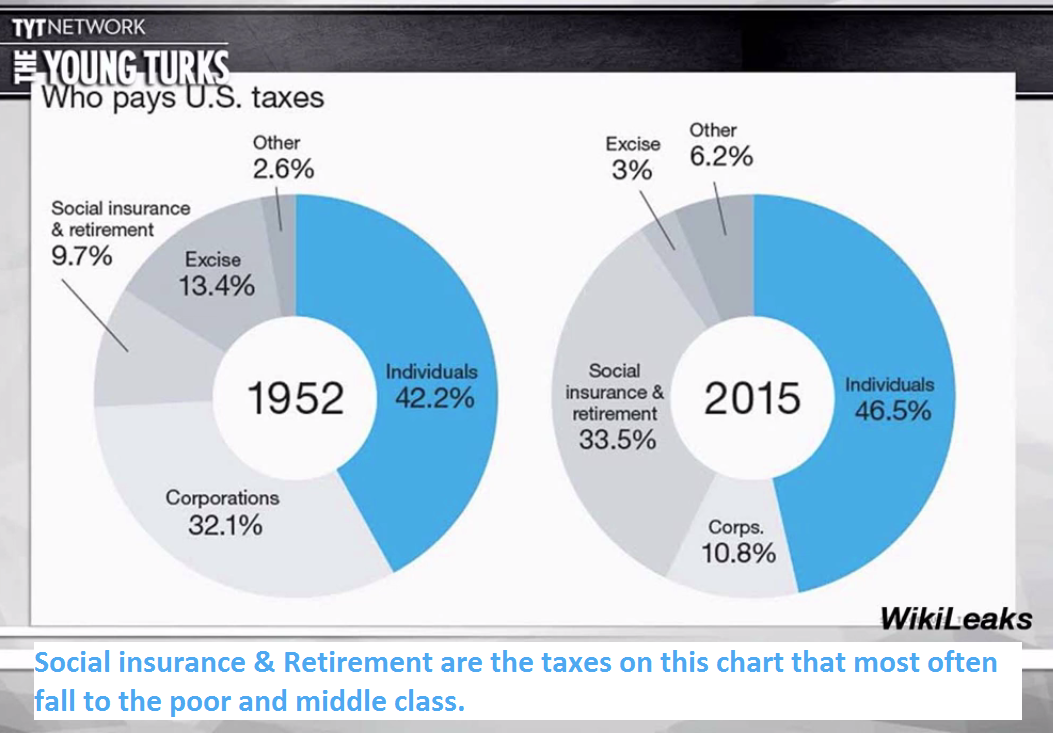
Since the Greatest Generation’s “Golden Age” taxes ave gone down for corporations and up for the poor. [screenshot of The Young Turks]
Just wanted to drop in here and share this astounding chart from yesterday’s “Hour One” of The Young Turks show. They shared this while building an argument against the Washington establishment consensus that budget proposals should be revenue neutral. As reported in Huffington Post,
But from the perspective of the [Elizabeth] Warren wing of the party, corporations pay far too little as it is, so making any plan revenue neutral is a loser. Before companies managed to start gaming the system, Warren noted, three out of every ten dollars of federal revenue came from corporate taxes, today it’s only one in ten.
Then he dropped this chart that shows how the tax burden in this country has shifted from corporations to the working class. Social insurance and retirement includes the Payroll tax, and it has tripled since 1952. Meanwhile corporate taxes are a third of what they once were.
Want to find out how that happened? Watch The Young Turks video below. In the video, host Cenk Uygur is cheerleading Elizabeth Warren’s one-woman battle against corporate tax holidays. A clear, simple argument. However, side affects of watching this video include rage, hair pulling, compulsive blogging, and sharing the above chart on social media.
I just wanted to pull that screenshot out, to make it easier to share on all the social things.
Elizabeth Warren: End Corporate Tax “Holidays” (The Young Turks)
Over 100,000 Bernie Sanders supporters have signed a pledge, saying they won’t vote for Hillary Clinton. The problem in answering the question, “is there a split in the Democratic party,” is that the goal posts on what it means to be a Democrat keep moving.
So there’s a clear message being sent that, despite their words to the contrary, the Democratic party doesn’t feel like Bernie Sanders is a Democrat at all.
The Democrats Need Those Sanders Votes
42% of Americans have no party preference, that’s compared to only 29% who are registered Democrat, 26% registered Republican. That means that no single party can win the election. It’s generally agreed that Sanders supporters are more likely to be independent voters than are Clinton supporters. Sanders pulls in voters who would otherwise vote for the Green Party, Peace and Freedom Party, or even Libertarian. This may be why he continues to beat Trump in nationwide polls, while Clinton’s numbers are flagging.
Whether or not those voters see themselves as Democrats, depends, in part, on what the Democratic party stands for. Independents aren’t fools, they understand a vote for a third party can’t have the same impact as the vote for one of the two major parties. These 42% of Americans don’t feel they owe their votes to Clinton (or Trump…not all of them will be progressive), because they already feel alienated enough from the establishment to register for a third party/no party.
Before Bernie Sanders entered the race, many of these people weren’t planning to vote Democrat at all. If his entry into the race brought in a bunch of new Democrats, the party’s reaction to this should be to welcome them with open arms. If they can’t do that, fine, they acknowledge that those votes were never the Democrats to claim in the first place. You really can’t have it both ways.
The recent events in Nevada only accentuate this. Why should the local Nevada Democratic party seek to disenfranchise or exclude Sanders supporters, if they see him as part of the Democratic party? Clinton supporters say bully to the Sanders delegates, that if the Nevada Democratic Party played the rules to exclude them, then it’s just too bad the Sanders supporters aren’t better at political gamesmanship. But there’s no reason that the Nevada establishment should be choosing sides in the first place, if Sanders delegates are indeed part of the democratic party. Rather, they act like they are fighting for their life, from an attack from within their own party.
This and so much more suggests that, at least to the establishment of the Democratic party, Berniecrats are not Democrats. One might say that Bernie’s calls for a revolution describe exactly this ambition to take over the party from the more progressive left, as the tea party did with the right.
What Is a Democrat?
However, if Bernie supporters aren’t welcome in the Democratic Party, where does that leave them?
The problem is that we have a two-party system. What makes it a two-party system isn’t the number of parties we have, but the way the candidates are chosen. There are more than thirty political parties to choose from in the United States. But those parties can’t gain a foothold, because the candidate with the majority takes everything. In contrast, societies with parliamentary systems award power by percentage. For example, if the libertarian party wins 30% of the vote, in parliamentary democracy the libertarians then would make up 30% of the congress. Whereas in the US, it’s winner-takes-all, no seats for second place. In order for a third party to have an impact, it would have to be the #1 overall overall winner, toppling both of the main parties…but if that were to happen (which it has, exactly once in American history) the third party would most likely take over the power of the losing party, rather than opening our democracy up to a third party system.
Therefore, if Bernie supporters are too progressive or too socialist for the Democratic party, that leaves them with no representation at all. They can join with the Democrats, or they can send a “message vote” that at best can only impact the election indirectly by pulling the main parties further to the fringe.
Because third party candidates are not likely to win, a vote for anything other than a Republican or a Democrat is seen as a “throwaway vote.” And if enough people “throw away” their votes on a more progressive spoiler candidate, the Democrats don’t get enough votes, and the GOP wins (or vice-versa).
If you’re an American, it’s *likely you already understand this. There’s a good chance you yourself have discouraged a voter from voting third party, because it will waste their vote, and if Trump wins it be “their fault.” You might have mentioned Ralph Nader.
Because the Democrats are further left than the Republicans, any progressive who wants their votes to count would have to vote Democrat. By this logic, if you believe that people should not vote for third parties, you believe that Berniecrats are Democrats by default. Regardless of who you support, there’s a logic here that can’t be denied. But there’s a problem too: it’s a paradox.
I’m starting to get pissed at HRC supporters claiming Sanders supporters “have to” support the Democratic nominee or it’s “their fault” if the GOP wins the White House. It’s irksome because it seems these same voters will argue that we shouldn’t support Sanders because his ideas are too grand or go too far… Fine then, if what I want is big, grand ideas, and the Democratic party can’t deliver them, they’re basically saying the Democratic party is not and won’t ever be our party. So why are we obligated to support them?
They can’t have it both ways. Don’t tell me I’m obligated to vote for a party if in the same breath you laugh at the notion of Democrats getting behind Bernie’s platform. And don’t claim Sanders and his supporters are really independents if you feel they owe their votes to Democrats.
*likely, but I’ve seen some voters who still don’t understand this, so I think it bears explaining.
You may have noticed a dearth of posts lately. That’s because I’ve been getting a lot more paid blogging work, and at the end of the day writing an extra blog post for a personal passion project hardly seems worth the time. But in the past week I got complaints from two people who told me they missed these posts, and relied on them to find new music. Meanwhile, a friend of my was lamenting that there were no new pop songs this summer as infectious as last year’s singles from Lorde. This was enough to spur me to action, as you know no phrase tickles my ranty bone like “They don’t make good music like they used to,” even when “they used to” was just a few seasons ago. My reply to such an audacious untruth is always, “CHALLENGE ACCEPTED.”
In fact, I’ve chosen to limit this post to girl pop singers, because, hey, I don’t have all day to tell you about all the great music out there so I need to narrow it down, OK? These aren’t fast-paced songs like you’d get from Dragonette or Icona Pop. As this post was inspired by Lorde, these are songs paced similar to her work, the kind of songs you could dance to, but will just as likely listen to while doing a thousand other tasks. They are songs that, like Lorde, reward repeat listening with interesting lyrics.
Julian Moon – Good Girl
Listening to Julian Moon reminds me of the first time I heard Sheryl Crow. It’s music that’s a little bit twangy, but too clean for country, and a little bit rock while still firmly cheery enough to be pop. This is one of those songs that is so clever, you’ll wonder how pop music has gotten along without it for so many years. The song is everything the “Good Girl” next door should be: sexy but approachable, familiar but unforgettable.
As of this posting, Julian Moon is offering “Good Girl” as a free download on Soundcloud, so there’s no reason her flirty voice shouldn’t be keeping you up all night, playing this number on repeat.
Hayley Kiyoko – Girls Like Girls
Hayley Kiyoko is also offering a free download, so I’m sharing the Soundcloud link below so you can grab it, but first I have to show you the video. I’m going to be honest with you, this video makes me more verklempt than Linda Richman at a Streisand concert.
This is me when I watch the Hayley Kiyoko video
I know there have been a ton of songs about girls liking girls, but for some reason this one feels really right to me. Many of the earlier bi-curious anthems feel more like they are in service to a man’s fetish than reflective of something real (I’m staring rudely at you, Katie Perry). At best, they are pointed political statements about equality. But “Girls Like Girls” is more like, “yeah, sometimes girls like girls, so what?” And I think that’s how the upcoming generation truly feels about it. I think this song makes me cry not because we need another gay rights anthem, but because of how casual the whole thing is. We waited so long for progress, so long it seemed impossible, and then it came all at once, so swiftly was justice brought about that a single generation later and the kids can hardly see what all the fuss was about.
Hayley Kiyoko – Girls Like Girls Video
So good, right?! Do you need a tissue? I do…every fucking time. And the chemistry between the girls is so true, like even though they’re not doing anything in the video, you can feel it between them. And the scene at the end, you can see not how much they lust for each other, but how much they care about each other.
As far as I know, Hayley Kiyoko isn’t queer, I don’t think she’s even in the video (however, she did direct it). She’s primarily an actress, a Disney actress no less, best known for parts in CSI and as Velma in Scooby Doo. And those are the sorts of things that would normally prejudice me against a performer. But based solely on this song, I can’t wait to hear what this Disney princess puts out next.
Now here’s the Soundcloud so you can buy “Girls Like Girls.” I hope to listen to it enough times that I can hear it without turning into Linda Richman.
Bebe Rexha – I’m Gonna Show You Crazy
If the queer pride movement has crested (and the trans pride movement is currently on the rise) I believe the next big social movement is going to be for the nutters. Half of everyone is on some kind of psychiatric drug these days, while social services for mental illness are either terrible or non-existent. Which is not to say that every dance anthem has to have some moral underpinning. I mean to say, there are always a lot of crazy girls on the dance floor and those girls will immediately embrace this song, dancing their asses off with fists pumping. Rexha has a sultry and powerful voice and the with the fierce music behind her, she makes Meredith Brook’s “Bitch” sound like a family campfire song in comparison. Though we may not all be medicated, I think everyone can identify with this song, that moment when you cut loose and decide to own all the labels thrown at you, and then some.
Alessia Cara – Here
You know that feeling when you’re at a party, and you’re just so ready to go home? There’s someone trying to talk to you, and they mean well, and it’s nothing personal, but they could really just drop dead as far as you care, and everywhere you look there’s annoying people making bad decisions, and you don’t want to force your friends to leave, but you don’t want to spend another second in these uncomfortable shoes, and this loud music? YES I KNOW YOU KNOW THAT FEELING. Because even I know that feeling, and I’m always the last person who wants to leave the party. Alessia Cara has captured that feeling perfectly in “Here.” She doesn’t just tell us, she shows us, with all kinds of details about her surroundings, and that’s what we call good writing.
For the main sections, she sing-raps in the way that has been popularized by artists like Keisha, but Cara has a fantastic voice, deeper and more sultry than I’d expect from one so young. But the lyrics are interesting and she sings them fast enough that you get sucked in, want to learn the words so you can sing along. The back up vocals and the single piano key give the song weight.
I have this song followed by a remix of it on my Hypem list, which means that when I listen to my playlist I hear it twice. I’ve yet to skip either version.
These four songs are fighting it out to be my new favorite thing in the world right now. They are the soundtrack for my summer. What’s yours?
Sansa Stark by EnjoyTheBlood
SPOILERS WARNING: This post assumes you’ve seen the first season of Game of Thrones or read the first book in A Song of Ice and Fire. There are spoilers for the latest episode, S05E03, “High Sparrow” but they are clearly marked in the post.
Make no mistake, Sansa Stark is one tough cookie. Sansa isn’t, however, a typical “strong female character” like her sister Arya. Her strength and power lie in her mind and in her ability to assess, adapt to, and manipulate situations by means other than brute force—something that’s rare on Game of Thrones. In show’s assortment of extremely powerful women, Sansa may fade to the background. But that’s actually part of her goal as a character, because she thrives by sticking to the shadows rather than attracting attention to herself.
The actress playing Stark claims Stark has figured out how to “weaponize femininity, how to turn what looks to casual viewers like a disadvantage into an asset.” Another article asserts:
It annoys me that people only like the feminine characters when they act like male characters. And they always go on about feminism. Like, you’re rooting for the people who look like boys, who act like boys, who fight like boys. Root for the girls who wear dresses and are intellectually very strong.
I too want traditionally feminine characters who manipulate their situation without brute force. But the problem is that Sansa Stark is not meant to be a powerful, feminine woman. She is written to be weak. On purpose. She is forthright when she should be withholding, emotional when she should be strategic. Always reacting rather than planning, always the victim, being batted from one danger to the next.
In fact, the entire clusterfuck of terrible events that happens in season one could all have been prevented if Sansa Stark hadn’t been so foolish to trust the queen mother with things she shouldn’t have said (I’m being vague here for the sake of spoilers). This intel gives the queen the chance to betray Sansa’s father, an event which sets in motion all the terrible things that befall Sansa and her family. Moreover, it’s not as though Sansa took a calculated risk that went awry. She naively thought the queen was her friend. Naivety, not inner strength, seems to be her primary character trait.
I feel like these feminists want to believe that George R.R. Martin has set Stark up as a “strong woman of intelligence” because they want to give him the benefit of the doubt, that he intended to have such a character. They want to believe that Martin means well. But they aren’t giving him enough credit. If Martin wanted to write a character who is “quietly wearing pretty dresses and pushing teacakes around on her plate as she maintains a façade, refusing to break character and betray herself” (as the Bitch article so nicely puts it) he would, and there would be no bickering about who she is and what she stands for. It would be clear. I know that, because he already wrote a character to fill that role, and it isn’t Sansa Stark.
(And no, it isn’t the mother of dragons either, though I think one could make a convincing argument that Daenerys Targaryen’s strength comes not from her army but from her strategy.)
The Strong, Clever, Feminine Heroine of Game of Thrones
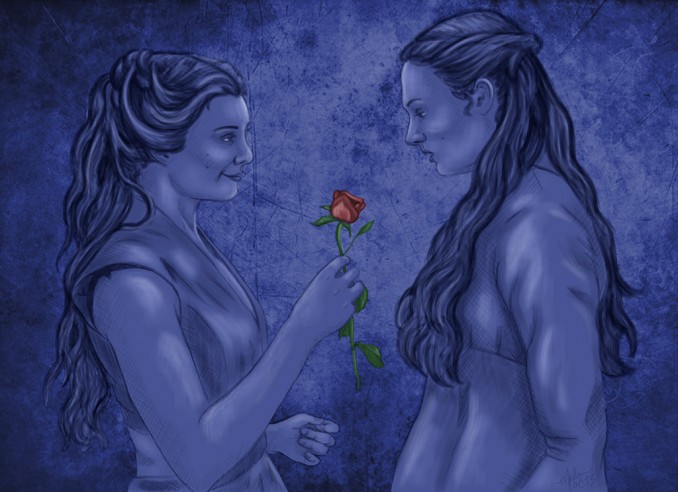
Margaery and Sansa by MiliaTimmain
If you want proof, then you need look no further than Margaery Tyrell. Margaery is easily a foil for Sansa, in that both of them have been engaged to the king, and both are living in the same lion’s den. But they handle this situation very differently.
Let’s compare. Sansa Stark had a schoolgirl crush on on the prince, Margaery recognized right away that he was a dangerous psychopath. Sansa Stark’s reaction to figuring this out was to plot her escape (an act that she was too timid to plan herself) while Margaery played on the prince’s sadism to get closer to his shiny, coveted crown. Sansa wants to be a Disney princess; she thinks nothing of politics beyond her own survival. Margaery went out among the people and heard their grievances, and was so bold as to challenge the queen about representing their interests. Sansa fails to recognize her natural ally in the imp, and is way too trusting of Little Finger. If their roles were reversed, there is little doubt that Margaery would have found countless way to exploit a marriage to Tyrion Lannister.
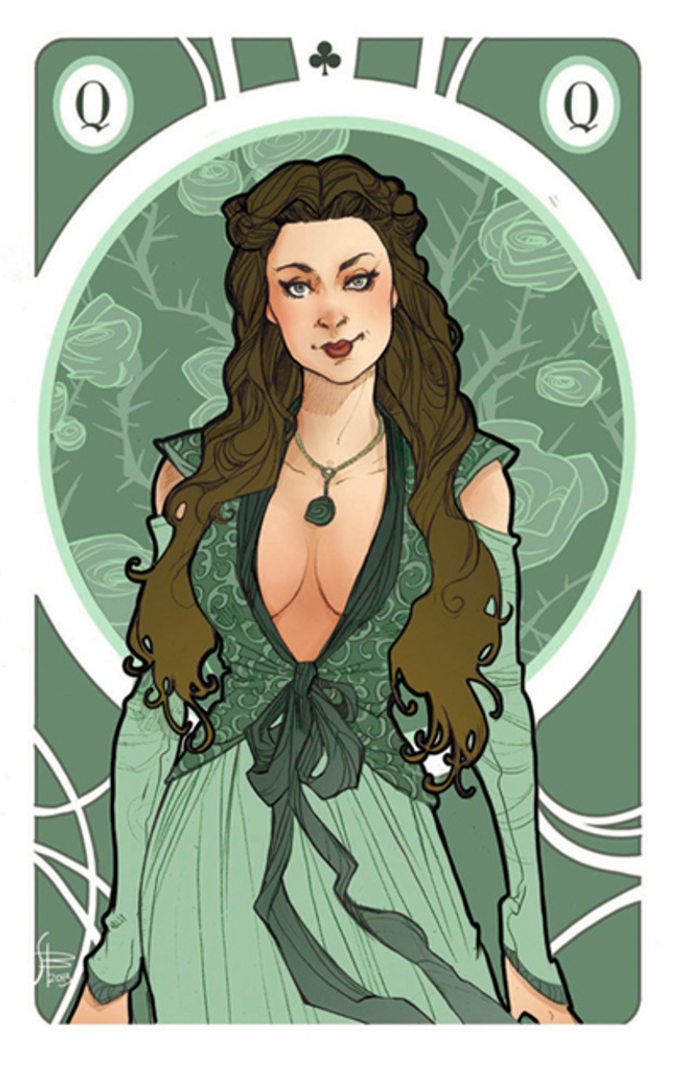
Margaery as a queen playing cardcredit: Simona Bonafini
Sure, Sansa lies about her allegiance to stay alive, but this doesn’t make her clever. It’s always tentative and tinged with fear. In contrast, Margaery lies to get what she wants. There are grey areas here: it’s partly due to Sansa’s disclosure that Margaery knew of prince Joffrey’s depravity. But the actions of Margaery show clearly how Sansa is meant to be perceived. Margaery is intended to be the feminine beguiler these other feminists long for while Sansa is intended to be read as weak and naive. Martin demonstrates this not only in their actions, but in the consequences to their actions.
For example, in the latest episode Sansa is again forced to lie **SPOILERS S05E03** when she is offered as a marriage candidate to the psychopaths who brutally murdered her people. Sophie Turner plays this perfectly, showing Sansa’s lies to be believable, while all the time you know she’s doing all she can not to scream bloody murder. Meanwhile, Margaery lies in this episode too. She speaks to the young king about his mother with words of flattery, her intended message buried so far down that when the king questions his mother, he doesn’t even recognize it as her idea. Then when the queen confronts Margaery, her false worship of the queen is laid on so thick the queen is left with no rational way to suggest Margaery may be at fault. Margaery is a gifted deceiver, she does it naturally and well and in the end it gets her what she wants, all the way to the crown. **END SPOILERS**
When Margaery’s ploys succeed, the author is showing us how clever and sly she is. All of her scheming is disguised as someone else’s idea. She plays the innocent, but is constantly advancing her position. She is smart enough to recognize that the queen is her biggest adversary, and daring enough to to look for opportunities to push the queen aside.
In contrast, Sansa Stark is where she is because she has little sense of who she can and should trust. The current scheme she is thrust into was not her idea at all, but Little Finger’s. Imagine if Margaery had the chance Sansa has, SAME SPOILERS AGAIN to regain her castle and avenge her people? I have no doubt not only would she be eager to wed the psychotic Ramsey Bolton but, critically, it would have been her idea. But because this is Sansa, and Ramsey Bolton is just about the worst character in a world of deplorable characters, we get the sense that the Little Bird is again being led into a terrible trap. END SPOILERS Sansa is still too naive to have schemes of her own.
While I don’t like Sansa Stark, I’m not with the unsophisticated reader who would have her shunted from the books, dying suddenly so we can get back to the other characters. I don’t see Sansa’s weakness as a failing of the author. Sure, in a world where most of the other characters are marked by their brilliance, honor, or strength, it’s easy to hate Sansa Stark, who is none of these things.
But we must remember that Sansa is barely more than a girl, and a royal at that, who has lived a sheltered life. Martin needs at least one character like that in the series to show us: this is what happens to naive girls (or boys) in a brutal world. If he killed her off, we’d not get to see how the slings and arrows of fate will turn Sansa into more than a survivor, but a leader.
Much of the world of Game of Thrones centers on this process. We watch young Arya turn from a little girl into a trained killer. We watch Daenerys Targaeryan learn to rule nations. These are plots that have developed not over chapters but over thousands of pages.
Those who would argue that Sansa is strong overlook that her weakness is a deliberate decision the author has made to show us that she is not ready to lead. That’s good writing. That’s character development. In the end, she won’t be another Margaery. Margaery has always been conniving. Her family raised her to be shrewd and careful. Every scene shows that is who she is; that is where she comes form. It makes her wicked, but likeable.
But Sansa is a Stark. She was raised to be honorable. Truth and justice were the values of her parents. She was taught that survival means looking out for your people (after all, winter is coming!) and there will be suffering in any case (did you hear about winter?). She was not taught to be shrewd, and this has led to the ample poor decisions that make her unlikeable. The choices she has made to stay alive go against all that the Starks hold dear. How will she become a worthy daughter to the unimpeachable values of her parents, while navigating a world where such honor will get you killed?
In the game of thrones, “you win or you die” so Sansa must sharpen up, or meet her father’s fate. Watching her story is like watching a pawn advance across a chess board. Martin has written her as a pawn, and rightly so, as her weakness makes the brutality of the knights and queens clashing around her more fearsome to behold. That little pawn keeps moving forward, and it is excruciating to watch unfold. But everyone knows what happens to a pawn that makes it across the board. That is what Sansa’s character is about: not who she is, but the powerful lady Stark she will become.
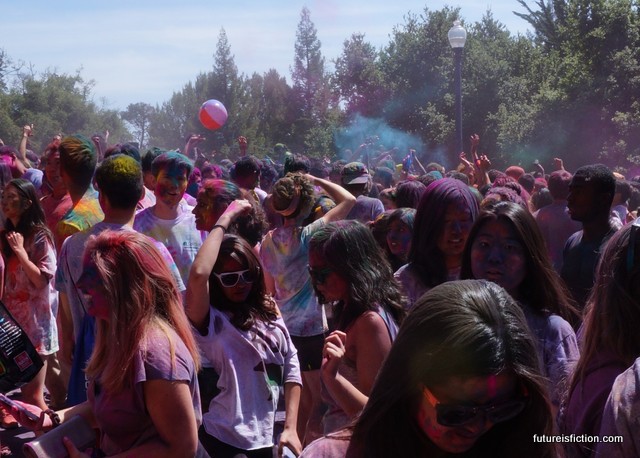
As Spring festivals go, Holi is among the most fun. Forget about the Maypole, during the Indian Holi festival people douse each other with bright colors. It usually takes place during March, but UC Berkeley’s Indian Student Association has their Holi celebration in April.
The UC Berkeley Holi festival is a dance party. The DJ mixed house hits with Indian pop music.
The event is free, and you can buy color from the Indian Student Association ahead time, or day of, until they run out. Ten packets (500 grams altogether) is sufficient but you could use twice as much so it really depends. Try to hold your colors until you make eye contact with someone. Though it can be tempting to merrily toss color into the air when the bass drops or even to toss a little color on someone’s back if their shirt is looking a little too naked of the stuff in your hand. More than once I gave in to this temptation.
Preparing for Holi
The colored powder is not paint. Some reports say it is made of corn starch, others say rice flour. In any case it comes right off in the wash, or even with a light sweep or pat of the hand. When shopping for colors make sure to get one that is non-toxic and all natural. Trust, you will get it in your mouth or up your nose at some point!
When dressing for Holi try to wear all white, so the colors will stand out on your clothes. In a sea of color splatters, the white spots on clothes stand out, begging to be marked.
There are only a handful of parking spots; most of the students walked from campus.
Some people bring squirt guns and water balloons. At UC Berkeley’s Holi most of the water play was in one area, so you could avoid it if you don’t like that aspect.
History of Holi
Holi Festival goes back to at least the fourth century. The word “Holi” hails from the demon Holika. The myth goes that Holika pulled a loyal Hindu into a bonfire while wearing her magic, fire-resistant coat. But Vishu saw and magically switched the coat to the loyal fellow, causing Holika to perish instead. Thus the Holi festival is a celebration of good defeating evil, similar to many other Springtime traditions that celebrate survival of winter.
Because of this Holi festivals often have a bonfire. Some say that the tradition of throwing colors comes from putting ash on the face in remembrance of the defeat of Holika.
Holi is the celebration of amnesty and renewal. Old debts are forgiven, others are paid. It is a day of cleansing oneself of regret and staring anew. In this way, though the calendar doesn’t change, it is similar to the American tradition of New Years’ Eve, but a lot more colorful.
A stranger and I toss color onto another stranger.
Check out Holi next April and join in the camaraderie. It’s a great way to talk to strangers. You are supposed to throw color on everyone, stranger and friend alike. This is the best part of Holi: walking up to someone you don’t know and having a brightly-colored laugh together.
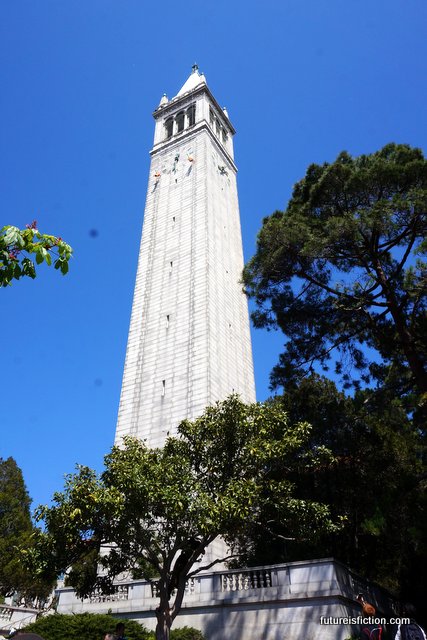
This is the Sather Tower, the best known landmark of UC Berkeley…probably the most recognizable building in all of Berkeley. It is one of the few landmarks in the East Bay you can recognize from most vistas in San Francisco.
Today the Sather Clock Tower (also known as the Campanile) turned 100. The Berkeley Clock Tower is the third tallest tower in the world (correction: third tallest university clock tower).
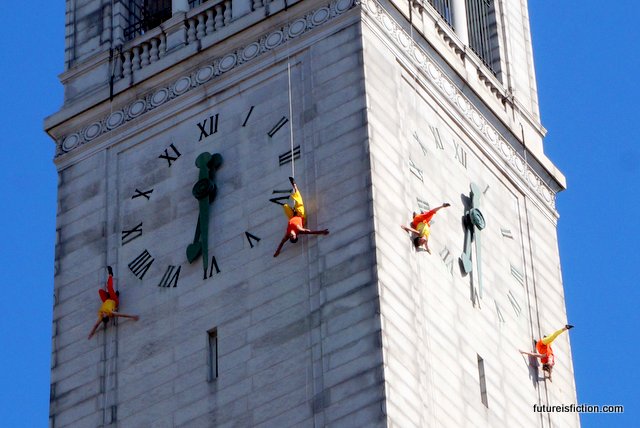
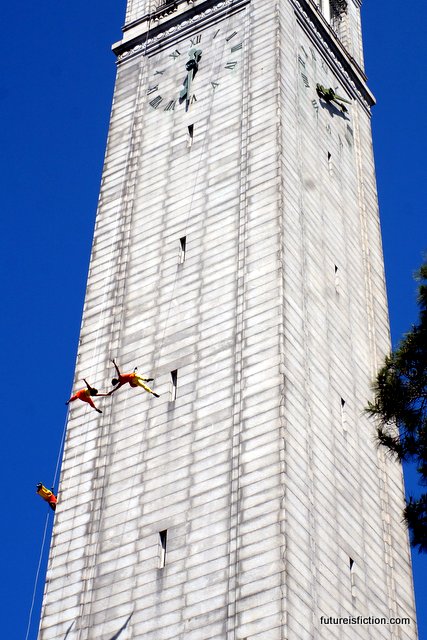
Did you notice the tiny yellow and orange dots at the top there? Those are people. Let’s get a little closer.
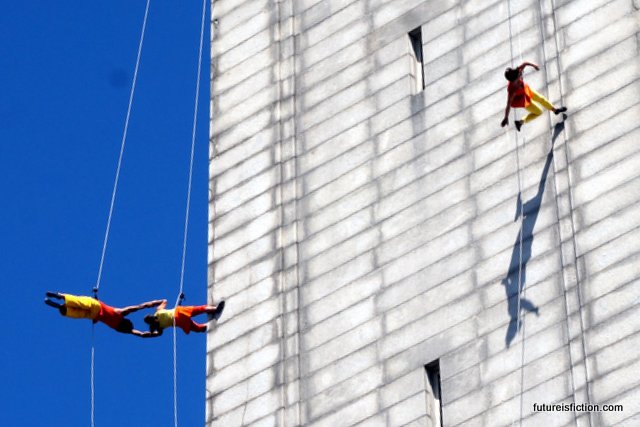
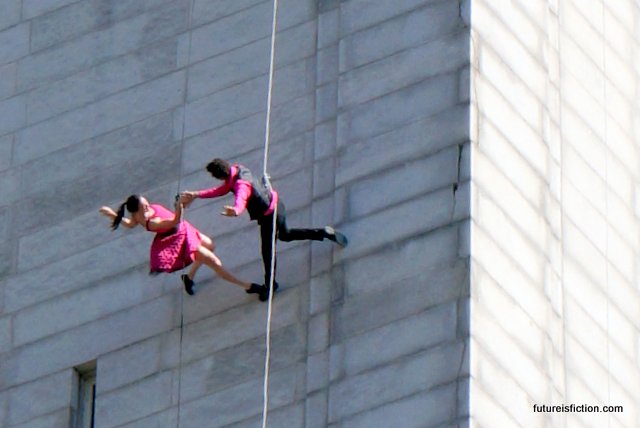
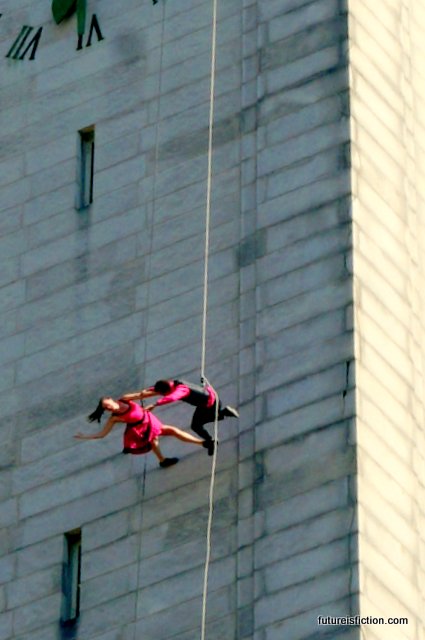
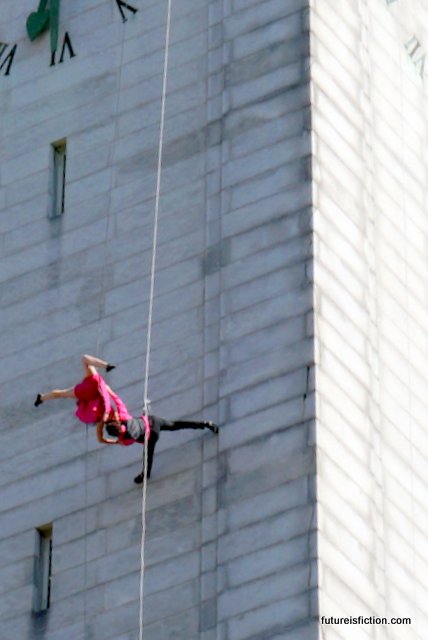
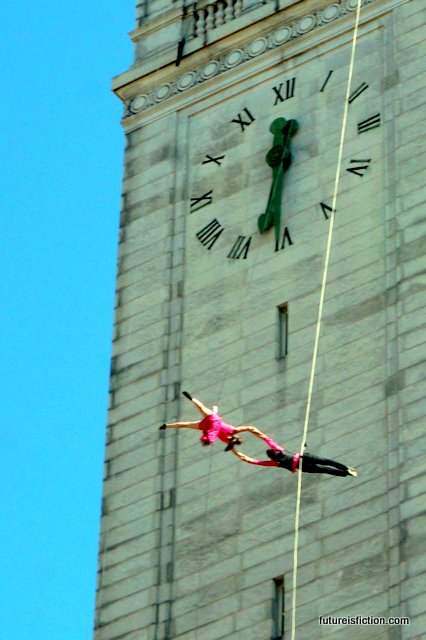
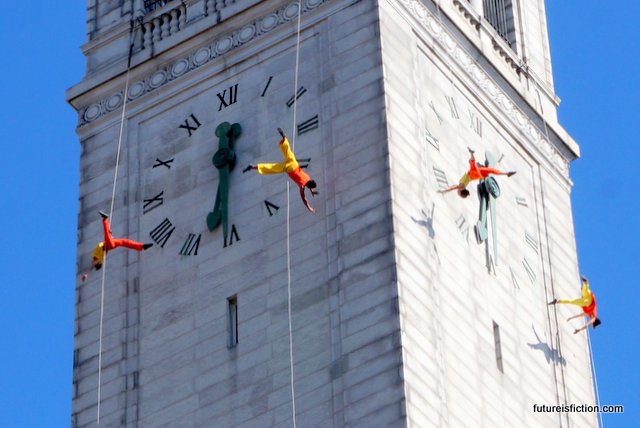
They’re acrobats. BANDALOOP do vertical dances hanging from the sides of buildings. Today they performed to celebrate the 100-year anniversary of the Campanile.
They started on the hour, so the dance was preceded by the sounds of the grand carillon of bells from the clock tower. It was a beautiful day, typical of the Bay Area. Hot and bright enough to burn you in the sun, surprisingly chilly inches away in the shade. We sat in the sun.
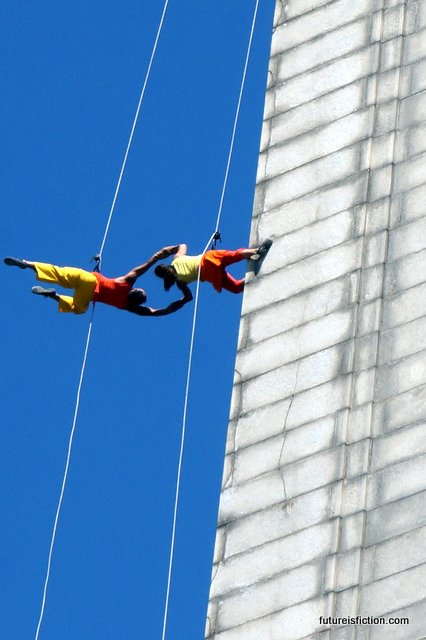
It was a solemn dance to music slow enough that the dancers seemed to flow. Like kites.
When they repel off the building, I wonder how hard they land. When they touched brick, sometimes they’d steady themselves, as if from a jolt. But only for a second, and they they’d leap off again, full of grace.
As BANDALOOP danced they’d gradually lower down their ropes, the song ending as they reached the bottom. I imagine they must choose music and choreography, in part, based on the height of the tower they are performing on.
The Berkeley clock tower is not empty.
Not by a long shot.
It is filled with fossils.
Twenty tons of fossils.
You think I’m writing some kind of poem here, but no.
I mean this literally. There are 300,000 pieces on five levels within the tower.
Or maybe it means something that they do their perilous dance over a building filled with death.
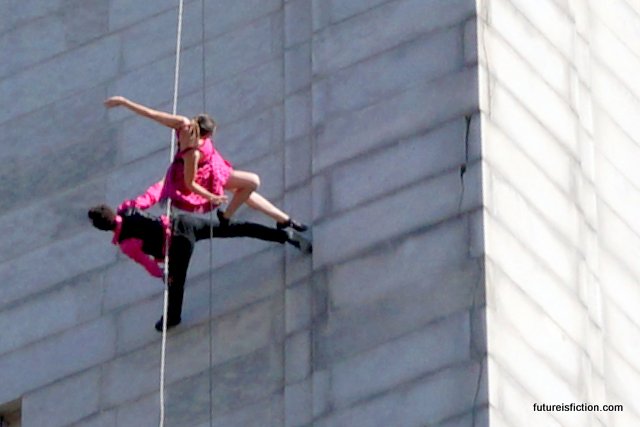
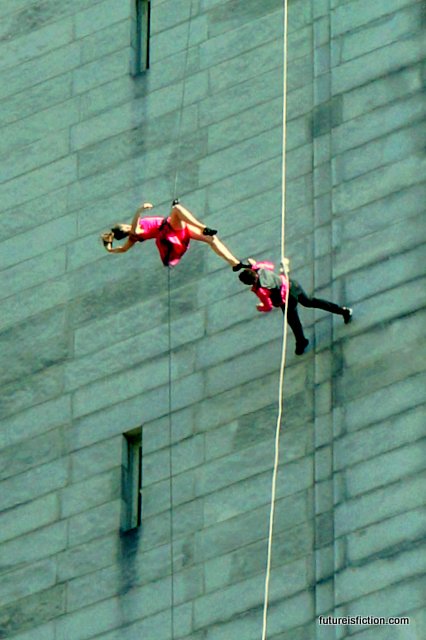
They also did a jaunty swing number. The big band music piped through the speakers was impressively balanced: full, but not too loud. The fast pace was a nice contrast from the other song.
Just like swing dancers. In fact, looking at these pictures, it’s easy to forget they’re not only dancing. But for the rope, it’s easy to think perhaps we’re looking down on ordinary dancers from above.
So we zoom out.
Did you know Carillonists play the clock tower bells with their feet as well as with their hands? It’s true.
Just one more photo of the aerial show.
Maybe this is off topic (again), but this morning I read a news story that declared the three worst places for renters are in the Bay Area. Oddly, instead of thinking, “gee, I should move,” I thought, “I hope other people see this and decide to move so the price of rent will go down.” I’m hooked on this place.
Maybe it’s not pertinent. But I see something like this, on a perfect day like today, and it feels all kinds of relevant.
You may have noticed it’s been a few months since my last post. Likely you didn’t, but I still feel I owe you an explanation. What follows are not excuses, merely facts. I never promised to post often, my only commitment is to making what I do share original and worth reading. But in case you are curious, here’s what’s been going on.
In August, I went to Burning Man
Only one post on the blog, but I did create a huge album and playlist as a gift to my burner friends. If you look closely, the link to it is hidden on this site. So I was writing a ton, but not so much blogging. It’s cliche to say so, but Burning Man was nothing short of awesome—in the traditional sense of the word: fearsome and awe-inspiring. Here’s a few photos from my trip.
In October I Went to India
I have three locations on my bucket list: India, Burning Man, and Barcelona. In 2014 I ticked two of these off the list and this summer I go to Spain. Don’t worry, this isn’t a made-for-TV-movie about a terminal patient looking to seize the day. The opportunities just presented themselves all at the same time, and I was in the lucky position in life to take them. Still, I know with this kind of luck I have to be on the lookout for falling anvils and black cats.
I did actually write a long post about India, but I’m still sitting on it. It’s controversial and I want to be sure I have my thoughts in order.
Here’s a tiny selection of the photos I took in India (really tiny, all of these are just from one day). If a web log is a journal, I know I should have written a post for each day of my journey. But I already put a lot of time into sharing all those photos with my Facebook friends, and really, do strangers on the Internet want to see my photos of India? I’m not sure if you do. Here’s that sample anyway.
In January I Got an Awesome Gig
After going home to visit my family (and surviving with zero drama! Amazeballs!) I was offered a writing gig for a kickass site. I’ve been doing copywriting for years here and there, but this was the first time I needed to write several posts a week. And I’m not just writing about lame stuff, but my favorite things ever: books and music.
At the end of the day, I often feel my writing urge satiated by my nifty job. Not only do I enjoy the content, I’m proud of my work there.
To get a taste of what I’ve been up to writing for my new client, here’s a recent interview I did for the site with PEN/Faulkner award-winner TC Boyle.
What’s Next?
As you can see, everything is just grand over here. No complaints and no apologies. But there are some other issues that have made me hesitate to type at’cha. I put a lot of work into setting up separate Tumblr blogs based on the themes I write about, but my love affair with Tumblr has gone sour. The culture of the site has become, at its worst, vindictive and mean. At its best, it is often shallow. But the real gripe I have with Tumblr is that when I share photos with my tablet or phone, they always come out pixelated, and my emails to support on this issue have never received replies.
Meanwhile, the music site I adore, wherein I have more than 42,000 followers, also stopped offering support. Most likely because of conflict with the recording industry, they killed all their uploads and now they only play YouTube videos. It’s not what it once was, and I’ve yet to find a suitable replacement.
You may think, what does Tumblr and some music site have to do with this non-Tumblr, non Blip.fm blog? Well Tumblr was motivating me to share my adventures in San Francisco. Blip.fm was motivating me to share great music. Both of these things would froth over the short form and, to continue the metaphor into cliche, the cream would rise to the top as blog posts.
Now I’m not sure how to proceed. Should I give up my Tumblr blogs, and just post everything here? If I do, there will be a lot more short content, like single songs and videos without so much explanation. But I’m not sure if I want that. I like that any post you click on here will have plenty of original content, and hopefully some new ideas too.
I’m still pondering these ideas. Maybe I need a rebranding. Maybe I just need a little encouragement. Maybe I will post here less often as people are kind enough to pay me to post elsewhere. But like I said, no apologies. This blog may be sparse lately, but not my life. My life is amazing.
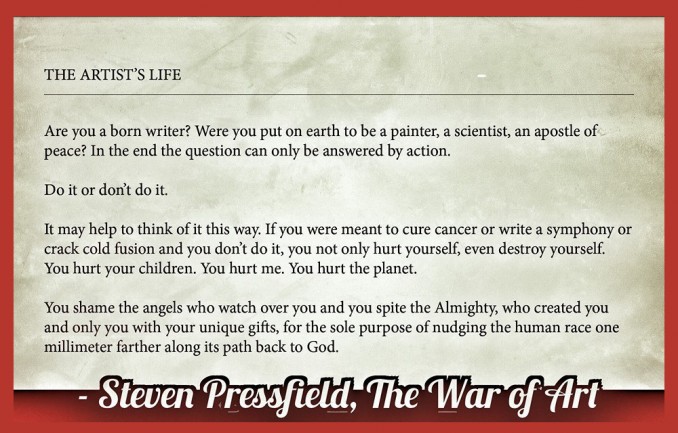
If you know the name Steven Pressfield, it’s likely because he wrote the book behind the hit movie The Legend of Bagger Vance. I’ve never even seen that movie, much less read the book, but have been eager to read Pressfield’s much-celebrated The War of Art.
It is a book on why to write, and a kick in the pants to get you writing now.
The War of Artis not only a book for writers. It is not even only for artists. It is for anyone who has a calling. Whatever it is that you feel in your gut like you were born to do, this book is to help you do that thing. I don’t mean the laundry or the grocery list. I mean that state where you find flow, that thing you do with effortless grace. In its action, you forget who you are, but in its completion you define who you are.
If you are the protagonist of The War of Art and the muse is your coveted lover, then the villain is Resistance. Resistance is Pressfield’s name for our tendency to fight doing the very thing we love. Resistance will tie your muse to the railroad tracks. It is your job to stop him.
The problem is, once you are good at something, it becomes easy for your ego to get in the way. You’re only as good as your last work, so your ego reminds you it would be better to never work again. That way you can’t risk creating something awful. And before we find flow, before we really get cooking, our deepest terror is that it won’t meet our expectations.
The better our last work is, the bigger our ego is. The bigger our ego is, the harder it is for us to create something new. From Axel Rose to JD Salinger, this is why celebrated artists stall. All you Game of Thrones fans are not helping George RR Martin finish the series with all that fan mail. To conquer resistance, he must conquer his own ego.
[ctt tweet=”The War of Art by @SPressfield: Because the biggest thing holding me back is me. http://ctt.ec/G26B9+” coverup=”G26B9″]
The War of Artis an easy read. The topic is one that many writers, and anyone who is obsessed with their own productivity, will be familiar with. He covers the battle against resistance in detail, which results in a short book. Which is fine. Read it slowly. At every moment you feel inspired, stop reading and go do the work (the fitting name of the sequel to The War of Art).
I’ll leave you with another quote. Let it sink in. Then get to work.
You know, Hitler wanted to be an artist. At eighteen he took his inheritance, seven hundred kronen, and moved to Vienna to live and study. He applied to the Academy of Fine Arts and later to the School of Architecture. Ever see one of his paintings? Neither have I. Resistance beat him. Call it overstatement but I’ll say it anyway: it was easier for Hitler to start World War II than it was for him to face a blank square of canvas.
I used to think I hated Christmas songs. I dreaded the moment when the manufactured atmosphere coming off the Wal-bucks speakers would all be playing songs from the same playlist of all that is snowy and ribbon-wrapped. But in my first December as an obsessed radio-streamer, I discovered many delightful Christmas songs I’d never heard before.
Now that ’tis the season once again I’m looking forward to it. I’ve come to realize that what I hated about Christmas music was the same thing I’ve come to hate about commercial radio: it’s all so overplayed. Based on the narrow selection of songs you hear every holiday, you’d think that a new Christmas song only comes along every other year. This is ridiculous, of course. There are thousands of bands making music every year and even if many don’t have the holiday spirit, still many others must still be tempted to hop on the Christmas-cash-cow band wagon. The oft-praised Sufjan Stevens has released his third Christmas album, for Santa’s sake! And you don’t hear a one of those on the radio. Even Cardiff’s hippest hipsters Los Campesinos! are getting in on the action with their Christmas album, A Los Campesinos! Christmas.
But just as Weird ole’ uncle Al likes to harp on about walking to school buck naked in forty miles of snow, I’ll take any opportunity to complain about the dismal state of radio. The moral to this story is that there are tons of great Christmas songs out there that, just like in every other season, aren’t getting any airplay. Here are a few of my favorite indie Christmas songs.
An indie rock song that’s as pure as A Christmas Story. Much like the kids of that old Christmas flick, the narrative of this song is all about that one coveted present. And like the young characters in A Christmas Story the crooners’ want is just sweet and naive enough to make the consumerism palatable. “Little Red Radio” is probably the most spirited use of an organ ever used in a Christmas song.
If you like your music weird and if you prefer Buy Nothing Day to Black Tuesday, this is the song for you. Barely a Christmas song and more of an anti-consumer artistic statement. (I wish more of Of Montreal’s music leaned more towards social criticism and less towards whimsical fantasy.) It’s quirks like this that make me love Of Montreal all the more; either you’ll love this or hate it.
Currently this is my favorite Christmas song. Many have voted Fairytale of New York as the best Christmas song of all time, and if you’re in that crowd, you’ll love this track too. Like the couple trapped in the drunk tank on Christmas, this song highlights how Christmas brings together people who aren’t always happy to be in the same room together. Hilarity ensues. It would be a great song if it weren’t the Hives with Cyndi Lauper, but seeing as how it is, double the greatness.






![Sansa Stark fan art by EnjoyTheBlood with the overlaid text "In the [stet] real life, the monsters win"](https://futureisfiction.com/blog/wp-content/uploads/2015/04/sansa_stark__by_enjoytheblood-d5849o1-678x381.jpg)






 Holi Festival goes back to at least the fourth century. The word “Holi” hails from the demon Holika. The myth goes that Holika pulled a loyal Hindu into a bonfire while wearing her magic, fire-resistant coat. But Vishu saw and magically switched the coat to the loyal fellow, causing Holika to perish instead. Thus the Holi festival is a celebration of good defeating evil, similar to many other Springtime traditions that celebrate survival of winter.