A cool new site just launched all about producing educational coding music videos. The idea is that if you’re going to get a catchy song stuck in your head, why not have those lyrics teach you HTML, the language of the web?
There’s still a lot of confusion about net neutrality and why it matters. And no wonder people are confused, even the media often gets it wrong. Take for example this recent statement from Real Time With Bill Maher.
There’s a big misunderstanding about what net neutrality actually is. What’s happening is you have certain companies like Hulu and Amazon, they’re streaming videos, and that actually takes up a lot of bandwidth. And so what they’re trying to do is make it such that those people pay more. Why should they pay as much as the woman on Etsy selling hair bows?
The point of regulation is not to be neutral. It’s to protect the little guy. It’s to create competition. Where we don’t have competition right now is with broadband providers. There’s very few of them. We need to have more competition in this space so that all of this flow continues to flow. I actually think a lot of politicians don’t really understand the issue. People making the rules really need to be under 32 to get this right.
Monica Mehta on Real Time with Bill Maher, proving she is over the age of 32
Bill Maher goes on to verify he too has no idea how the Internet works with two simple words, “good point.”
Nope, noppity nope. Mehta’s heart may be in the right place, but her facts are painfully wrong. You can listen to Monica Mehta’s quote on net neutrality here, it begins at 47:30 and goes on for a minute…one little minute, and yet this statement is riddled with problems.
Now to unravel all the ways she got it wrong, so you don’t make the same mistake.
1. Mehta is Confusing a Web Host With an Internet Service Provider (ISP)
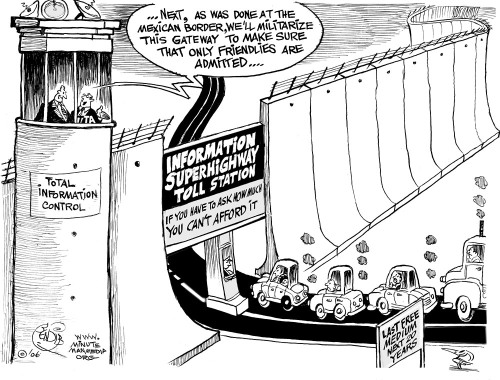
Net Neutrality is about free speech of humans over the “free speech” of corporate dollars. [comic via Oddysseus9]
Big companies do pay more for streaming video. They pay that money to their web hosts, which provides the computers where their websites live. Granted, a big company like Netflix probably owns their own servers, but they are definitely paying a lot more for bandwidth than some seller on Etsy.
(Further showing her lack of clarity on this, the gal on Etsy pays $0 to a web host—instead she pays Etsy to use their site and then Etsy pays a web host, but that’s nitpicking and besides the larger point.)
Every person who visits a web page is downloading data from the web host, so the more visitors a site has, the more they will have to pay in bandwidth fees. These transactions are between the company and the web host, they have nothing to do with the Internet Service Provider (e.g. Comcast).
Comcast is not hosting the sites for these big companies, they simply provide the pipe that sends it into your laptop and living room. They are a middle man, and in the tradition of middle men everywhere, they now want to charge extra fees. Net neutrality is about not allowing them to do that.
2. Those Opposed to Net Neutrality Aren’t Advocating Government Regulation
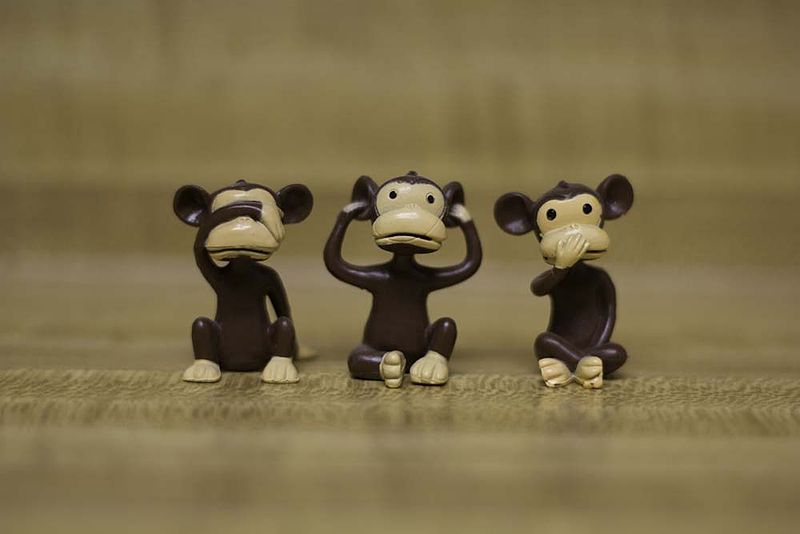
LA LA LA LA LA…I’M SURE COMCAST WILL DO A FINE JOB REGULATING THE INTERNET [image via Wikimedia]This isn’t “government regulation” any more than it is when we cover our eyes and allow factory farms to self-regulate. So when she says “the point of regulation is not to be neutral” she is further confusing matters. Comcast is not a regulator. They are a business, looking to profit.
In this particular case, they want to charge Netflix more because Netflix competes with them as a cable provider. It would be like Barnes & Noble marking up the price on all copies of The Idiot’s Guide to Amazon.com. That’s all fine and dandy until Barnes and Noble is the only bookstore in town, which is the case for most Internet Service Providers.
Are you a blogger? If you are, you may be interested in the post I wrote today for 40tech.com on how to access your site’s log file. You can see who’s looking at your site, and what they’re reading, all in real time. You can also check out your error log to figure out why something on your site isn’t working. It’s pretty nifty, and it’s a good foray into accessing your site directly via the command line.
Also, I found a link that explains how to read the contents of the Log file. Some of it seemed obvious to me, like the numbers are the IP of the person checking out your site and the GET: postname.html is the page they’re looking at. But this was something I wouldn’t have intuited:
The sixth piece of information is a status code. This tells you whether the request was successful, or encountered some problem. Most of the time, this is 200, which means that the transfer was successful, and everything went well. Hopefully. I’m not going to give the whole list of the status codes, and what they mean. You need to look in the documentation for that. But, in general, a status code that starts with 2 was successful. Starting with a 3 means that the request was redirected somewhere else for some reason. Starting with a 4 means that the user did something wrong, and starting with a 5 means that the server did something wrong.
Good to know. Both articles are very easy to read and understand even for someone with absolutely no experience using the command line.
I wrote another post for the popular tech site 40Tech.com. It's comparing the popular music communities Blip.fm and Turntable.fm. Please check it out and comment to help it make their "Popular" list! Here's the link: http://bit.ly/blipvsturntable
There’s been a lot of talk lately about the “future of publishing.” After all, books have never had as much cash to spare as the recording industry, and look at the mess they’re in. Already it is not so difficult for a self-published manuscript to sell itself on Amazon.com. What will happen when everything goes digital? The suggestion is that there will be an opening of the gates, and the latest best-seller will stand on the same virtual shelf with thirty self-published manuscripts. The optimists claim that this is where the great unpublished books will be discovered and pessimists point to the unleashed masses of poorly thought-out, half-written tomes filled with spelling errors. But it doesn’t matter if fantastic self-published books are available if they’re drowned out by countless other books vying for the consumer’s attention.
I’m thinking of this issue again because Chuck Wendig just wrote a post on this very subject. I must requote a quote that he included in his piece from a Salon.com article (“When Anyone Can Be A Published Author“)
Furthermore, as observers like Chris Anderson (in “The Long Tail”) and social scientists like Sheena Iyengar (in her new book “The Art of Choosing”) have pointed out, when confronted with an overwhelming array of choices, most people do not graze more widely. Instead, if they aren’t utterly paralyzed by the prospect, their decisions become even more conservative, zeroing in on what everyone else is buying and grabbing for recognizable brands because making a fully informed decision is just too difficult and time-consuming. As a result, introducing massive amounts of consumer choice leads to situations in which the 10 most popular items command the vast majority of the market share, while thousands of lesser alternatives must divide the leftovers into many tiny portions.
Chuck says in response, ” that doesn’t sound like what will happen when the FUTURE OF PUBLISHING is made manifest. It sounds like what happens right bloody now.”
As it is, there are about 100,000 brand new titles published and printed every year, and it is fair to say that even the most devoted readers may touch 1/100th of that. If you include self-published books, the number of books published is 600,000 to a million. That doesn’t take into account the thousands of reprints of absolute classics that exist. I am pretty sure that if I devoted my entire life to reading I would not get through every book on my imaginary wish list before I breathe my last breath. Now imagine compounding this with an onslaught of unpublished manuscripts, from gorgeous to garbage, that would land on the market place if the result of this revolution were a totally leveled playing field. What would happen? Continue reading Some Predictions About Books By Way of Some Predictions About Music→
Those who’ve been watching the plucky start-up were already aware that Facebook is mired in accusations that it was founded by a crook and funded by a nut and some gooks. Into this fray comes Facebook’s controversy over their privacy settings. It used to be that Facebook provided a space that was just for friends and family. “Just” as in “only.” As in, not public.
The new privacy settings even led to a movement last month to have a “Quit Facebook Day.” Even if you manage to tackle FB’s labyrinth of privacy settings, don’t use any apps, or never use FacebookConnect you still can’t control what happens when your friends fail to make their stuff private. You can’t stop Facebook from censoring your messages. Even if we all flock back to Myspace or Friendster or Tribe [or Whatever] we have no guarantee that that data won’t be given away. It would probably be wise to consider anything hosted on a faraway computer you can’t control as potentially public, even email. At the very least we should commit to using sites that have consistent and reasonable privacy policies (thus the total opposite of Facebook [1][2]).
But entrusting Facebook is clearly no longer the way to go. Here’s why. In my myriad conversations about this issue, I get one of three responses:
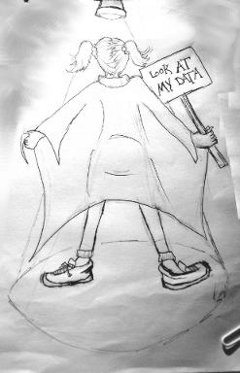
“I don’t care about who sees my data or my friends’ data. I posted it so anyone could see it.”
This person shouldn’t be on Facebook. There are much better public sites that do everything Facebook does but better and more beautifully (more on that later).
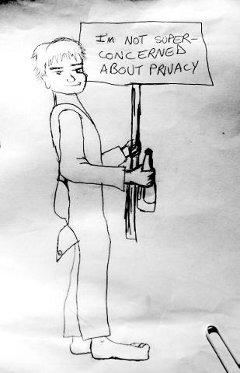
“Privacy isn’t a big deal to me but there are some things I’d like to put online that I don’t want the whole world to see.”
This person shouldn’t be on Facebook. These are the people Facebook seeks to confound with their myriad privacy on-off switches, e.g. most of us. Because these folks aren’t too concerned about most of what we put out there, we won’t be meticulous about making sure everything is set to private. We won’t think of our Facebook stream as a blog for all the world to see and eventually we will accidentally post something that will get us embarrassed, fired, divorced or deported.
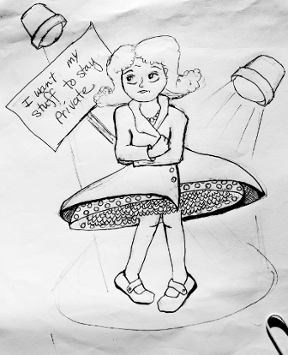
“privacy is very important to me. I only want to share stuff with my friends.”
This person shouldn’t be on Facebook. Because this person cares about privacy. If anything, they should be boycotting Facebook. Wake up: Facebook wants our info to be public so they can make more money on their ads. Facebook CEO Mark Zuckerberg has admitted he’s ok with the whole thing being confusing because he doesn’t believe in privacy.
Oh the outrage!
But alas, Quit Facebook Day has come and gone and your account still remains. Don’t feel too bad…so does mine.
Now that Facebook has decided to make it standard to share people’s stuff, why are we still using Facebook? Simple: because no matter how much better the other sites are, Facebook is where the people are. But having all the people didn’t stop Myspace fom sinking or Friendster before it. We just need a critical mass of people to join these other sites and Facebook will be history.
The thing is: we don’t need Facebook! Even if Facebook were offering a reasonable privacy policy there are much better sites. And here’s the good news! They all allow automatic posting to Facebook. For those of us not boldly motivated enough to quit Facebook, we can follow our friends on these sites while automatically sending updates to those still lost in the land of blue and white status updates. Eventually these sites (which are all still relatively new) will grow full of enough users that we can all jump ship.
“But,” I hear you asking, “what are these wondrous websites?” Patience, dear reader, for you have discovered the subject of page two…
What is the Maker Faire? It’s bad-ass-art and tech-as-art.It’s steampunk and 8-bit. It’s hackers and coders. It’s robots and lasers and explosions. It’s cities built of legos or recycled cardboard. It’s the art of Burning Man without the burning heat. It’s zinesters, knitters, stitchers, and crafters. It’s virtual reality and 3-D and glow-in-the-dark LEDs. It’s giant Tesla Coils. It’s long-lost arcade games and the technology of tomorrowland. It’s gadgets and gizmos a plenty, whosits and whatsits galore. And more specifically, it’s Make Magazine’s huge conference celebrating acts of glorious creation.
I was fortunate enough in that this year I was able to attend both days for free because I was helping out with my pals at Simbol Rides. So I alternated between helping folks in and out of their personal motion simulators and checking out the hundreds and hundreds of booths that make the Maker Fair so overwhelmingly nifty. Our booth was in the big room between the woman who grows her own sheep to make her own wool, the museum of Pinball, and the city of Legos.
Much excitement today surrounds Firefox’s fifth birthday. We’re reminded how this product that seems indispensable to us today didn’t even exist in 2004. Firefox usage is a clear line that separates the old fogies and Luddites from the young, hip and with it. Indeed I can’t even imagine who these sixty percent are that still use Internet Explorer—perhaps people so behind they don’t know what a web browser is, and therefore haven’t figured out you can use a different one?
Most of us have experienced the frustration of trying to convince someone that it really is worth the five minutes it takes to download and install Firefox because the features it provides will improve your life on a daily basis. I want you to take a moment to dwell on this feeling, until your brow is furrowed in relived vexation. I’m asking this, dear reader, because in moments you’re going to do the same thing to me.
What if I told you that there was a browser out there that was hands-down superior to Firefox, Chrome, Safari and (of course) Explorer? This browser is never mentioned on the articles comparing Firefox’s rise to its lesser competitors. And since the techno-sphere is spending the entire day fawning over the Mozilla wonder-child, I get to experience this annoyance all day long. So I’m going to take this opportunity to patiently explain to you, for the second time, why you should download the Opera web browser immediately. Because I care, dammit. Now get that glazed look off your face, the one you see when you try to explain to grandpa how to send a text message.
Remember when you figured out that tabbed browsing saved a bunch of memory and was way more convenient than having twenty windows open? It was a big part of why many people switched over to Firefox. Yeah, tabs: Opera invented that. Not only that, they do it better. You can resize your tabs. Hovering over a tab creates a preview. You can duplicate a tab. You can create “follower” tabs: Once designated, any link you click in the current tab will open in the follower tab. When you close a tab it goes to the most recent one you used, not the first in the list: a small thing, but having it do the other way in Firefox drives me bananas!
I made my tabs huge, but you can have them normal-sized too
You can select any text and right-click to save it as a note. This feature has saved me so much time! Fuck notepad!
When you hit the back button, Opera keeps the page in the cache, so it loads instantly. I cannot understand why other browsers don’t do this.
You know how sometimes you’re on a webpage that’s coded for a larger screen and you keep having to scroll to the right to read? Opera has a little button that will fix that: “Fit to Width.” So simple it’s brilliant.
You’d be forgiven if you didn’t know Firefox has added the “recently closed tabs” option, because it is buried in their history menu. Opera had this feature first, and they put it in a more convenient location to the right of your tabs.
There is a magical thing called a Torrent file that allows people to download large files exponentially faster than a normal download. To use one of these files, you need a separate program like BitTorrent. That is unless you’re running Opera, where you can download the entirety of Army of Darkness with a single click because they have torrent downloading within the browser.
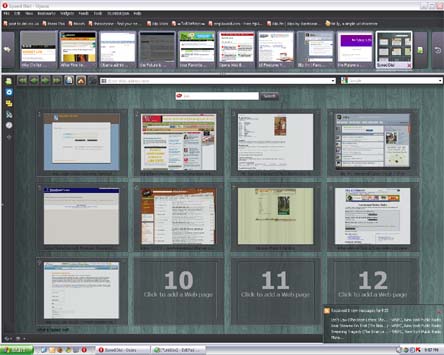
A new tab has a speed dial where you save your favorite sites. I think some other browsers are adopting this now, but in Opera you can change the size and layout of your speed dial, and even put any image as a background. You can also run any speed dial by typing it’s number into the url. So when I open a new tab, I can click on the little pic of my gmail to take me right there. Or, in the window I’m in, typing the number “two” and hitting enter will take me there. That’s faster than Brittany Spear’s little sister!
Please keep reading! Or Hula girl gets a lethal shot of Opium!
It’s little shortcuts like these that make me miss Opera when I’m stuck on someone else’s computer. Opera has a number of these, but the one that won my heart is the ability to run every search from the URL bar. I have tried explaining this to Firefox users and they point to their lame-ass Google toolbar. Yeah, I have that in Opera too and it’s collecting dust. Why? Because it’s only convenient if you’re searching Google. If you want to search wikipedia, you have to scroll down, switch to wikipedia, run the search, and then remember to switch it back to Google. In Opera, I can type “w anal fisting” directly into the URL bar, hit enter, and I’m learning the ins-and-outs from Wikipedia as soon as the page has finished loading!
Speaking of the URL bar, in the newest release, you can make a nickname for any site and run it from there. So if I want to visit the Glenn Beck website, instead of typing glennbeck.fox.com (or whatever), I can set it to be called “crazytown.” Then I only have to type “crazytown” in the URL bar and I’m there!
These are not all of the features that Opera has on other browsers, merely the ones that keep me hooked. I’ve been trying to get you people to try Opera since September of 2006, out of the goodness of my heart, but no! You don’t listen.
Admittedly I still love and use Firefox too. The thing Firefox still has going for it is that, because it is so popular, it has a lot more apps. And the developers won’t start making the cool apps for Opera until you (and you and you and your cousin Lenny) start using Opera. And I want those apps!
Dammit! I’ve shown my true colors. So you see I had a selfish motive after all.
Who cares! It’s better! Just stop blinking at me inexplicably and go download it!
Janet said she wanted to go the Missouri Lounge to make fun of all the hipsters. Everyone agreed that The Missouri Lounge was just crawling with the little buggers.
I was surprised. Not about the Missouri Lounge—though I’d always thought the shack looked like more of a redneck dive—but that Janet wasn’t herself a hipster. She had the chunky, short-cropped hair and the thick black plastic glasses. But no. She was a hipster hater. How could I get them confused?
We ordered drinks and Janet picked out the most egregious violators and made fun of their outfits and drink selections. We did not stay long. Janet made a request from the DJ and there was some misunderstanding, or altercation. So we left.
That incident got me thinking. Did those people deserve to be made fun of? What made them worse people than Janet? What the hell was a hipster, anyway?
Since that day many moons ago, if I hear someone use the word I always ask them what it means. Two things quickly became apparent: 1) no two people seem to have the same definition 2) never have I ever heard the word used in a positive context.
For my money, a hipster is a person with an overly-developed sense of irony. But by that definition, the guy I know who is most likely to be a hipster is a 35-year-old Indian metalhead. He’s also the biggest hipster-hater I know. The “H-word” also seems to be associated with indie rock, though no one seems to know what the fuck that is either.
Here is what some of my research has come up with:
“Hipsters are trust fund babies who go to expensive private art programs.”
“Hipsters are people who wear mismatched, ill-fitting clothes and think they are hot.”
“Hipsters are the shallow types who live in the Williamsburg neighborhood in Brooklyn.”
“Hipsters drink Pabst Blue Ribbon and ride fixie-bikes and make fun of normal people.”
Oh well then, that’s clear. If I am in Williamsburg and I meet someone in an art program I can assume they are shallow and living off daddy’s money. Additionally, if I meet a girl on a fixed-gear bike in Goodwill frocks I can assume she is a snotty bitch who can’t wait to talk about me behind my back. It would do the world a good deed to run off with her inexpensive union-made brew, taunting and laughing.
Much like the yuppies in The Last Days of Disco, “hipster” seems to describe a group of people whom everyone seems to agree is omnipresent and easily identifiable yet no one can find one among their circle of friends.
In case you can’t tell, this whole thing pisses me off. Being cruel to someone based on the way they dress, the music they listen to, their neighborhood or school of choice is discrimination. It may not be based on a thousand years of oppression like the prejudice we all like to think we’re too good for, but it is certainly the opposite of the moral high-ground the hipster-haters think they have.
The American College Dictionary defines Bohemian as “a person with artistic or intellectual tendencies, who lives and acts with no regard for conventional rules of behavior.”
I see very little to distinguish the hipster-hating of today from those who hated the punks and before that the hippies and before that the beatniks and on and on. No one can deny the fact that the hipster is the new bohemian, except the bohemians themselves, who’ve been tricked into thinking that the hipsters are the fake bohemians.
Can’t wait to meet this friendly guy!
Thus we have an odd scenario where sews-her-own-clothes girl (e.g. hipster) and shops-at-the-Gap girl (eg the anti-hipster) can both commiserate on how much they hate the shops-at-Urban-Outfitters girl (“fake” hipster). SewsHerOwnClothes thinks she is immune because she is more authentic than those people who shop at Urban Outfitters. But you can bet your best pair of Pumas that Gap girl and the Urban Outfitters “fake” hipster would be just as quick to make fun of the freak girl with the weird clothes she she probably made on her grandma’s sewing machine (as if that’s a bad thing).
The whole anti-bohemian attitude strikes me as a backlash against a group of people who feel slighted by those who have a different set of moral standards. An example would serve better than an explanation…
Someone who thinks that they are being “special” and “unique” for liking some underground bullshit no one else cares about. And they pointlessly look down on people who don’t know anything about indie culture, because that’s the only thing they know anything about. They’re quick to call the rest of the world conformists when in reality, they are the ones conforming by partaking in a “too cool for mainstream so i am going to reject it by looking and acting like a grungy asshole” way of life only to seem uber-fashionable. They just end up looking like idiots.
Hipster: I won’t drink at starbucks, it’s too corporate.
Non-Hipster: I want a Louis Vitton purse because they are cool
Hipster: You’re such a conformist, haveing [sic] a Louis Vitton purse is so unoriginal. I like my purse I found in the gutter for $4 dollars.
Non-hipster: but it’s fugly
Hipster: yah, but no one else has it. It’s completely unique.
Non-hipster: that bum over there has something pretty similar though.
Hipster: You’re ignorant because you can’t see the real beauty in life.
I don’t have time for this, I’m gonna go to my cave of an apartment and listen to some indie rock you’ve probably never heard of….
Non hipster: You need to see a therapist
Hipster: I am my own therapist.
So the sad fashion whore who wrote that definition feels as though she is being judged because she doesn’t care where her clothes are made or how her consumption choices affect the local economy. And she’s right! I think the person who wrote the definition above is shallow and ignorant! I expect to be hated and unkindly labeled by anyone who thinks avoiding Starbucks is an example of “some underground bullshit.” That’s totally fine. Fuck that girl, and the guy who runs http://www.latfh.com, we were never meant to be friends!
But when I see the anarchists, punks, queers, ravers and other manner of adorable bohemians bitching about the “H” word, it’s too much. When someone seeks to say cruel things about a nonconformist, hipster is the first word they turn to, even if the nonconformists themselves think a hipster is something entirely different.
The focus on the hipster’s inauthenticity as an outsider, art appreciator, or moral consumer is a defense mechanism based on the labeler’s own insecurities in those same areas. The Louis Vitton-lover in the example above is an extreme example because s/he can’t even conceive that anyone would care about the journey of their designer purse from sweatshop to landfill. Your average anti-bohemian likes to think they appreciate art and philosophy as much or more than any weirdos with their weird music and their weird hair and their weird clothes. The assumption is that any reasons for being different are not better or coming from any set of values, merely contrivances. In this way, anti-hipsterism becomes another extension of the big-city-elitist versus corn-fed-anti-intellectual debate that is the hallmark of the American class system.
When the freaks, geeks, queers and quacks take aim at hipsters they are supporting conformity, regardless of what they think it means when they are around other bohemian-types.
Let us celebrate the hipster. Let us drink inexpensive beer and wear used clothes. Let’s listen to obscure music. Let’s have debates about crap surrealist literature and condone veganism. La vie Boheme, under any name: embrace it.
My boyfriend got miffed at me a few weeks ago. I had put his email in a list that would invite him to join Shelfari. Though he was slightly annoyed to get email from them, he was more annoyed that I gave this site my google name and password. It really didn’t occur to me that this was possibly insecure.
I would have challenged him as paranoid but the day before I had been downloading aps for facebook. I came across a particularly lovely app that would auto-check your myspace and tell you if you had any updates. But the programmer who wrote the nifty app had taken it down. He had an accidental security hole that allowed the username and password to be transmitted transparently, causing malicious folks access to the email info of those who had the installed the application.
I have to remind myself that just becuase I trust the programmer that wrote the program not to do anything shady with my info doesn’t mean that its safe to pass it along.
Here’s another way to look at it: If you have a password, one reason you don’t give it out to those you trust is because if there is some kind of security breach — whether it be a home robbery or online identity theft — you can detective* out how your password got into the wrong hands. The more people who have access to your info, the more difficult that is. And I have heard of cases where the source wasn’t resolved and the same asshole cracker** came back and socked the victim again.
This is particularly telling, as google is so widely respected. I don’t know about you, but I’m holding my passwords a little closer to my chest in the future.
 There’s been a lot of talk lately about the “future of publishing.” After all, books have never had as much cash to spare as the recording industry, and look at the mess they’re in. Already it is not so difficult for a self-published manuscript to sell itself on Amazon.com. What will happen when everything goes digital? The suggestion is that there will be an opening of the gates, and the latest best-seller will stand on the same virtual shelf with thirty self-published manuscripts. The optimists claim that this is where the great unpublished books will be discovered and pessimists point to the unleashed masses of poorly thought-out, half-written tomes filled with spelling errors. But it doesn’t matter if fantastic self-published books are available if they’re drowned out by countless other books vying for the consumer’s attention.